Strategy
Strategy, business model and value chain (SBM-1)
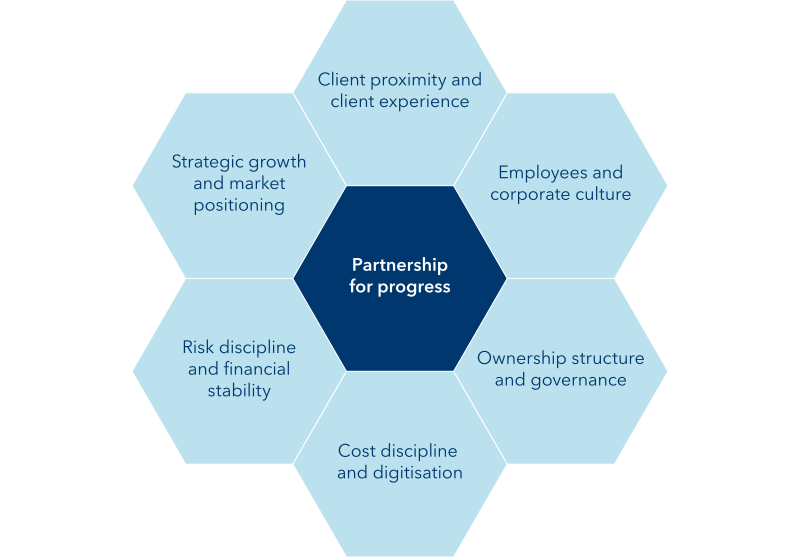
VP Bank's strategy centres on its domestic market in Liechtenstein and select international client groups within the private clients and intermediaries business. VP Bank aims to achieve sustainable growth in these segments, build on its existing strengths, and solidify its market position in the long term.
Since its foundation in Vaduz in 1956, VP Bank has grown from a small, family-like bank to become one of Liechtenstein's three systemically important banks, as well as an internationally active financial institution. Employing around 1,000 people, the bank provides expertise, flexibility and first-class, personalised solutions.
Clients benefit from:
- an understanding of client needs, even across national borders;
- personal wealth planning, asset management, and investment advisory;
- very good investment performance, including in multi-year comparisons;
- a modern and user-friendly client platform;
- reliability thanks to above-average capitalisation, a strong liquidity position and anchor shareholders with a long-term focus.
Business model
VP Bank was founded by Guido Feger, a successful entrepreneur and one of Liechtenstein's most prominent trustees. Building on this legacy, VP Bank has become a trusted partner for financial intermediaries and high-net-worth private clients.
The business model includes:
- the universal bank in its home market Liechtenstein;
- a partner for intermediaries such as trustees, external asset managers, lawyers, family offices, and fund managers;
- a specialist for private clients with complex needs in the areas of asset protection and investment;
- Asset servicing for third-party and private label funds.
VP Bank aims to achieve the following objectives with its business model:
- VP Bank is a well-established bank in Liechtenstein, offering a wide range of services for everyone, from simple savings accounts to personal investment advice, financial planning and comprehensive financing options.
- VP Bank is the preferred partner for intermediaries. The bank also aims to achieve a leading position among external asset managers in growth markets. In Liechtenstein, VP Bank is the first choice for trustees.
- VP Bank is a recognised specialist in wealth management and asset protection for high-net-worth private clients in selected markets. The bank is also the leading provider of premium real estate financing in the British Virgin Islands.
- In Asset Servicing, VP Bank is the one-stop shop for alternative investment funds.
Information on the respective segments’ revenue shares and other financial disclosures by them can be found in the “Segment reporting” section of the Financial Report 2025 of VP Bank Group. Information on the number of employees in the different regions is provided in the chapter S1-6.
Sustainability strategy
VP Bank is continuously working on economically viable sustainability measures and their targeted anchoring in the various business segments. VP Bank can contribute to the achievement of international sustainability targets primarily through its range of products and services. An overview of the metrics and targets already introduced can be found in the corresponding chapter ESRS 2 MDR-T. The sustainability strategy and targets have been defined within the context of the overall strategy and, above all, make a direct contribution to the following strategic success factors: strong corporate culture, robust risk management and a future-oriented long-term strategy.
VP Bank bases its decisions and actions on the following principles:
- Supporting clients in achieving their sustainability targets with its range of products
- Focusing on key sustainability topics that VP Bank can directly influence
- Integrating sustainability criteria into investment advisory and wealth management processes
- Cooperating and engaging in dialogue with stakeholders to drive improvements in terms of sustainability
- Communicating transparently concerning activities and progress in achieving targets
VP Bank recognises environmental, social and corporate governance factors as being relevant for long-term financial success and ensures that the management of core business segments assumes responsibility for sustainability measures. Responsible business practices involve the application of minimum protection measures in order to minimise any adverse impacts associated with the bank’s business activities. This includes compliance with human rights and labour law, combating money laundering and adhering to the principles of the UN Global Compact and other due diligence requirements as described in chapter G1 IRO-1. VP Bank is committed to the Paris Climate Agreement and develops measures to reduce operational emissions and specific on-balance-sheet financed emissions.
Value chain
The value chain (VC) covers all activities carried out by the organisation itself and its upstream and downstream units for the purposes of providing products and services, from development through to final use. VP Bank has defined a model VC in order to assess impacts, risks and opportunities (IROs) throughout the entire VC. This is based on internal information and publicly available industry information. The model VC at VP Bank is divided into three stages: upstream processes, the bank’s own operations and downstream activities.
Hotspots have been identified for the three stages of the VC, allowing for structured identification and further analysis of potential and actual IROs. In the upstream and downstream VC, hotspots have been identified with reference to the countries and industries in which IROs are concentrated. Country-specific IROs address potential challenges and uncertainties that VP Bank may face in relation to activities or investments in certain countries or markets. Sector-specific IROs refer to aspects that can arise when VP Bank operates or invests in specific industries. These risks arise from a combination of economic, political, social and regulatory factors that may affect business activity, profitability and sustainability.
Within the ambit of the upstream VC, a tier 1 supplier analysis was carried out in which suppliers were examined according to region and product category. The downstream VC focuses on lending business and investments. The mortgage business plays a central role in the lending business, particularly from a sustainability perspective. In the area of the bank’s own investments and client assets, considerable differentiation has arisen as a consequence of broad geographic and industry diversification. The resulting geographic and sectoral IROs have been taken into account in the analysis and evaluation. Further information on the VC at VP Bank can be found in chapter ESRS 2 IRO-1.
The purpose of the Supplier Code of Conduct is to ensure that suppliers of VP Bank adhere to high standards with regard to safe working conditions, fair and respectful treatment of employees and ethical behaviour. As a medium-sized enterprise, VP Bank has limited market power, and in some instances none at all, in its target markets. As a result, only limited influence can be exerted on VC actors. VP Bank only has limited scope to influence its business relationships and their impact. VP Bank is one of the three largest financial institutions in its home market of Liechtenstein, which can give rise to some degree of influence.
Interests and views of stakeholders (SBM-2)
For VP Bank, stakeholders include all organisations and persons that place financial, legal, operational or professional demands on the undertaking. Stakeholder dialogue plays a central role in the implementation and review of the bank’s sustainability efforts (see Table 1). VP Bank engages in dialogue with internal and external stakeholder groups. VP Bank strives to promote a culture of responsible action by means of group-wide training and awareness-raising measures.
Detailed information on stakeholder engagement in the double materiality analysis process and how this process has been shaped by VP Bank’s stakeholders can be found in chapter ESRS 2 IRO-1. The sustainability-related measures and targets defined with reference to strategic objectives are identified based on the results of the materiality analysis. This means that stakeholders’ opinions and expectations are incorporated into strategic adjustments. The findings and results relating to key sustainability topics, including IROs, obtained from the double materiality analysis have been presented to the Board of Directors and Group Executive Management and used as a basis for decision-making.
Stakeholders | Type of commitment | Objective of the commitment | Responsibility | Description |
|---|---|---|---|---|
Clients |
|
| Group Products & Solutions | The process for engaging with clients is described in detail in chapter S4-2. |
Employees |
|
| People & Culture | The process for engaging with employees is described in detail in chapter S1-2. |
Board of Directors and Group Executive Management (GEM) |
|
| Group Sustainability; Sustainability Board | The information channels for administrative, management and supervisory bodies and their frequency are set out in the context of sustainability governance. Further information can be found in chapter ESRS 2 GOV-2. |
Shareholders, investors and financial analysts |
|
| Corporate Communications & Investor Relations | VP Bank is obliged to publish price-sensitive information in each case as ad hoc announcements pursuant to Art. 53 of the Listing Rules of SIX Swiss Exchange. This includes the semi-annual financial results followed by a media, analyst and investor conference, which is broadcast live on our website. Investor Relations is in regular contact with financial and sustainability analysts and organises road shows for investors and potential investors. On request, investors can also arrange discussions with Investor Relations and/or the CEO and CFO at other times. |
Suppliers and business partners |
|
| COO Office | VP Bank published a new Supplier Code of Conduct in 2024. Compliance with the ethical and social standards defined therein is not only expected but demanded of all of the bank’s business partners. The aim of the Supplier Code of Conduct is to promote ethical conduct and compliance with laws throughout the supply chain, support sustainable business practices and ensure compliance with human rights principles. |
Local communities and NGOs |
|
| Group Sustainability | VP Bank is actively involved in the Sustainable Finance Workshop run by the University of Liechtenstein. VP Bank employees discuss scientific papers and thus make a positive contribution to promoting research. In addition, employees participate in conferences, seminars and panel discussions, thereby promoting dialogue with actors from society and science. |
Authorities |
|
| Group Sustainability | VP Bank is an active member of the Sustainability Section of the Liechtenstein Chamber of Commerce and Industry (LIHK) and the Sustainability Committee and the Sustainable Finance Section of the Liechtenstein Bankers Association (LBV). |
Memberships
Voluntary commitments provide a practical guide for dealing with sustainability topics. They are a tool for covering areas that are not yet explicitly regulated and provide market participants with guidance and a standardised approach. For VP Bank, group-wide membership of various initiatives is an important aspect of knowledge sharing with its stakeholders. For this reason, VP Bank supports initiatives that provide it with the opportunity to contribute to sustainable development, to learn from experts, to share knowledge and experience, to find out about new topics and to support its strategy and commitments.
Membership | Abbr. | Commitment/purpose | Member since |
UN Principles for Responsible Banking | PRB | VP Bank is committed to assuming greater responsibility for climate protection and responsible business practice. | 2021 |
UN Principles for Responsible Investing | PRI | VP Bank is committed to responsible investments wherever it makes the investment decision. | 2021 |
Drink & Donate | D&D | Partnership to give people long-term access to clean drinking water. | 2017 |
UN Global Compact | UNGC | Taking responsibility in four areas: Human rights, labour, environment and anti-corruption. | 2016 |
Material impacts, risks and opportunities and their interaction with strategy and business model (SBM-3)
The table below summarises material positive and negative impacts and the risks and opportunities identified as part of the double materiality analysis for VP Bank. No findings are currently available on the expected financial effects of material risks and opportunities. Information on climate scenario analyses can be found in Chapter E1-1. The periods under consideration for the qualitative and quantitative assessment are based on the information set out in chapter ESRS 1. Detailed information concerning the methodology can be found in chapter ESRS 2 IRO-1.
Sustainability topic | Value chain | Type of impact | Materiality of the impact | Financial materiality | ||||
|---|---|---|---|---|---|---|---|---|
Climate change (E1) | Downstream (credits) | Negative (actual) | High | Financed emissions in the mortgage portfolio have a negative impact on climate change. The real estate sector contributes significantly to total emissions in Liechtenstein and Switzerland, where more than 90 per cent of the financed buildings are located. However, two-thirds of the buildings were built after 1980 and are therefore partly to fully energy-efficient. | Moderate | Stricter climate-related regulations can lead to additional restructuring costs that affect the borrower’s ability to repay and thus increase the default risk of VP Bank. Extreme weather events can cause adjustments to real estate prices and depreciation in the value of collateral. | ||
Downstream (investments) | Negative (actual) | High | Emissions financed through investing activities have an impact on climate change. The negative impacts are primarily focused on a few CO2-intensive sectors. | Moderate | Stricter climate-related regulations and guidelines can lead to a reassessment of financial investments, which in turn can lead to financial risks for VP Bank as a result of losses on investments. | |||
Own workforce (S1) | Working conditions | Own business | Negative (actual) | Moderate | The actual negative impact on employees in terms of working conditions is low. This is due to industry membership and the strict national legislation in the locations where the bank operates. While the physical impacts on employees are limited, the psychological impacts can have an effect due to work-related stress and intensive working hours. | High | Dissatisfied or overwhelmed employees can cause errors, business interruptions and increased risk of fraud. In VP Bank’s own operations, non-compliance with labour laws and regulations can lead to legal risks, fines and reputational damage. | |
Own business | Positive (actual) | Moderate | Actual positive impacts on employees’ working conditions can be achieved in many ways, including flexible working arrangements, health and wellness programmes, benefits packages and learning and development opportunities. However, such programmes have been standard in this industry and in this geographical location for a number of years, and additional services are limited in terms of their scope and extent. | High | Improving working conditions, for example by providing ergonomic workspaces, can improve well-being and productivity among employees. Attractive working conditions, including competitive salaries, social benefits, appreciation and a positive work environment, can help banks attract and retain top talent, leading to lower staff turnover and higher earnings. | |||
Consumers and end-users (S4) | Information for consumers and end-users | Access to (high-quality) information | Downstream (credits) | Negative (potential) | Moderate (short-term) | Client satisfaction and client security are top priorities. No transactions will be carried out with clients that are known or must be assumed to be unable to meet their resulting obligations. This applies, in particular, to the issuing of loans. | High | We see it as our duty to ensure that clients are transparently informed about their credit obligations and are realistically capable of fulfilling them. If this is not the case, this can have negative financial consequences for the client. |
Downstream (investments) | Negative (potential) | Moderate (short-term) | Client satisfaction and security takes top priority. VP Bank ensures that clients are offered products that match their ESG preferences and risk profile (MiFID II). Product-related information is provided either directly to clients or via the website, including disclosure obligations regarding sustainability (e.g. SFDR). | High | Misleading or inaccurate product information may result in unexpected financial losses exceeding the tolerable level. | |||
Business conduct (G1) | Own business | Negative (actual) | High | Due to its own business activities, VP Bank has a major influence on business conduct. This includes dealing with general professional ethics issues such as taxation and accounting, anti-competitive practices and intellectual property issues. The possible impacts of granting and accepting advantages and financial crime in the banking business are also included. | High | Corporate culture and risk management play a key role. VP Bank may be exposed to operational risks in connection with internal errors and misconduct, which may result in financial losses. In the case of misconduct related to money laundering and the fight against financial crime, the financial risk is very high. The financial market authorities take action against specific cases of misconduct and may hold individuals accountable. The banking sector is very sensitive to negative press. A scandal about business practices can lead to considerable client losses and long-term reputational damage. | ||
Downstream (credits) | Negative (potential) | High (medium-term) | Potential negative impacts may occur in the construction industry in connection with corruption and bad practices. Strict requirements in Liechtenstein and Switzerland (>90 per cent of financed buildings) lead to a low probability of occurrence. Hidden clauses in mortgage contracts, non-compliance with regulations, inadequate credit checks or conflicts of interest can also have negative impacts. The impact on clients in the event of inadequate viability can be high. | High | Lending practices can help banks manage credit risks effectively. By avoiding excessive risks, defaults and non-performing loans can be avoided, preserving the capital and profitability of the bank. | |||
Downstream (investments) | Negative (actual) | High | Negative impacts from violations of international standards and conventions (e.g. UNGC, ILO, UNGP) can occur in internationally diversified investment portfolios. This can be actively managed through effective risk management and responsible investment practices. | High | Exposure to violations of international standards and conventions (e.g. UNGC, ILO, UNGP) can undermine client trust and negatively impact assets under management. At the same time, negative reporting on human rights violations can lead to a severe, unsustainable adjustment in asset prices, which in turn negatively impacts the portfolio’s performance. | |||