Compensation report
The compensation report sets out the principles applicable to and the components of compensation, equity-participation programmes and allocations comprising the compensation of the Board of Directors and the Members of Group Executive Management (GEM). It also contains information concerning compensation schemes and compensation paid to Members of the Board of Directors and GEM for the 2025 financial year.
Regulatory framework
The basis of the compensation policy of VP Bank is the implementation of the Regulation (EU) No. 575/2013 with reference to Directive 2013/36/EU (CRD V), which, among other things, regulates the risks associated with compensation policies and practices.
On the one hand, Liechtenstein has implemented this Regulation in the Banks and Finance Companies Act (Banking Act, BankA), in particular in Art. 7a(6) and 7(c) thereof.
The Directive on Information Relating to Corporate Governance (DCG) and the DCG Guidelines dated 1 January 2023 set out the specific requirements governing the disclosure of compensation paid to Members of the Board of Directors and Group Executive Management for companies listed on SIX Swiss Exchange Ltd. In issuing this compensation report, VP Bank complies with this obligation.
Compensation policy
Acting on the basis of regulatory requirements, the Board of Directors has issued compensation policy regulations for VP Bank Group, which are reviewed annually in order to ensure that they are up to date, compliant and reasonable.
For a number of years, the compensation policy of VP Bank Group has corresponded to the size of VP Bank, its internal organisation and the scope and complexity of its business model. This primarily encompasses the offering of banking services for financial intermediaries and private clients in the disclosed target markets, in Liechtenstein and at the international locations. In addition, the Group has an international fund competence centre. Details of the business model can be found in the Strategy and targets chapter.
Principles of compensation
Compensation plays a central role in the recruitment and retention of employees. VP Bank subscribes to fair, performance-oriented and balanced practices in terms of compensation which are in keeping with the long-term interests of shareholders, employees and clients alike.
The principles applied are laid down in the compensation policy.
- The compensation policy and practices of VP Bank Group are simple, transparent and sustainability-oriented – especially with regard to environmental, social social and executive management aspects. They are in line with the Group’s business strategy, objectives and values, as well as its long-term overall success, and take its equity situation into account.
- Performance orientation and performance differentiation are substantive components of the compensation policy and ensure the interlinking of variable compensation with the achievement of the strategic goals of the business.
- The compensation policy is compatible with and helps foster robust and effective risk management. It makes sure that compensation-based conflicts of interests of the functions or persons involved are avoided. The assumption of excessive risks by employees to increase compensation in the short term should be prevented where possible by setting appropriate incentives.
- The compensation policy renders possible fair and attractive compensation in line with the market to enable VP Bank Group to attract, motivate and retain qualified and talented employees. Conformity with market conditions is reviewed regularly.
- The compensation system is not founded on a purely formula-based approach and therefore possesses sufficient flexibility to take account of the business performance of VP Bank Group or its subsidiary companies.
- Compensation practices follow the principle of equal treatment. The level of fixed compensation depends on the function. The level of variable compensation reflects Group performance, the performance of the segment or team and/or individual performance.
- The compensation policy is subject to regular review. Relevant legal provisions are applied and implemented in compensation practices. Prescriptions specific to functions, in particular those relating to identified employees (risk takers), are taken into account.
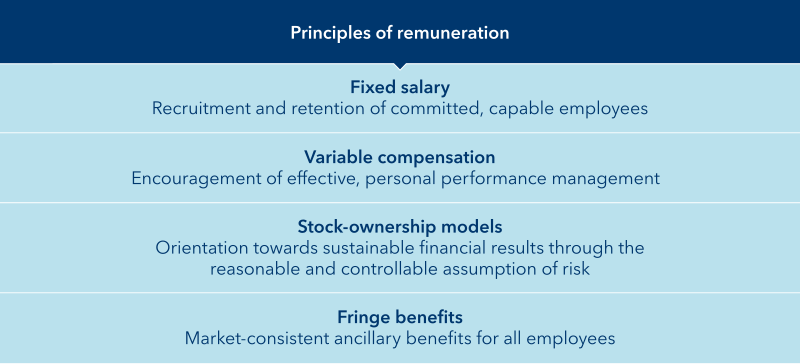
Components of compensation
The total compensation of the employees of VP Bank Group comprises a fixed compensation component, an additional variable salary, an equity-participation programme, as well as additional perquisites (fringe benefits). In laying down the structure of compensation, an appropriate relationship between the fixed components and variable compensation as well as a function-specific compensation component is taken into account. In particular, risk takers, which include Group Executive Management (GEM), receive a maximum variable compensation component which complies with the legal ratio to the annual salary (maximum of 1:2). Limitation of the ratio of fixed to variable compensation at VP Bank to a maximum of 1:2 was approved by the shareholders at the 53rd annual general meeting on 29 April 2016.
Fixed compensation
The annual salary set out in the individual employment contract and payable in cash in monthly instalments forms the basis of compensation. The level thereof varies in accordance with the function exercised and the demands and responsibilities deriving therefrom which are assessed based on objective criteria. This enables internal comparability as well as equal treatment in compensation matters and also permits a comparison with market data. VP Bank considers the fixed compensation component to be compensation for the employee’s activities performed in an orderly manner. The fixed salary is reviewed annually for ongoing appropriateness within the scope of the salary and wage round negotiations and, where necessary, adjusted.
Variable compensation
The variable compensation component can consist of a directly paid-out portion as well as of deferred compensation instruments.
- Immediately payable variable compensation (bonus): The bonus is the part of the variable compensation component settled annually in cash as compensation for the contribution made to earnings in the previous financial year. Should the bonus be particularly high in relation to overall compensation, a part of the payment thereof can be withheld. Where it appears sensible and appropriate, such withheld portion can also be settled in the form of deferred compensation instruments or in the form of equity shares which may not be disposed of during a limited period.
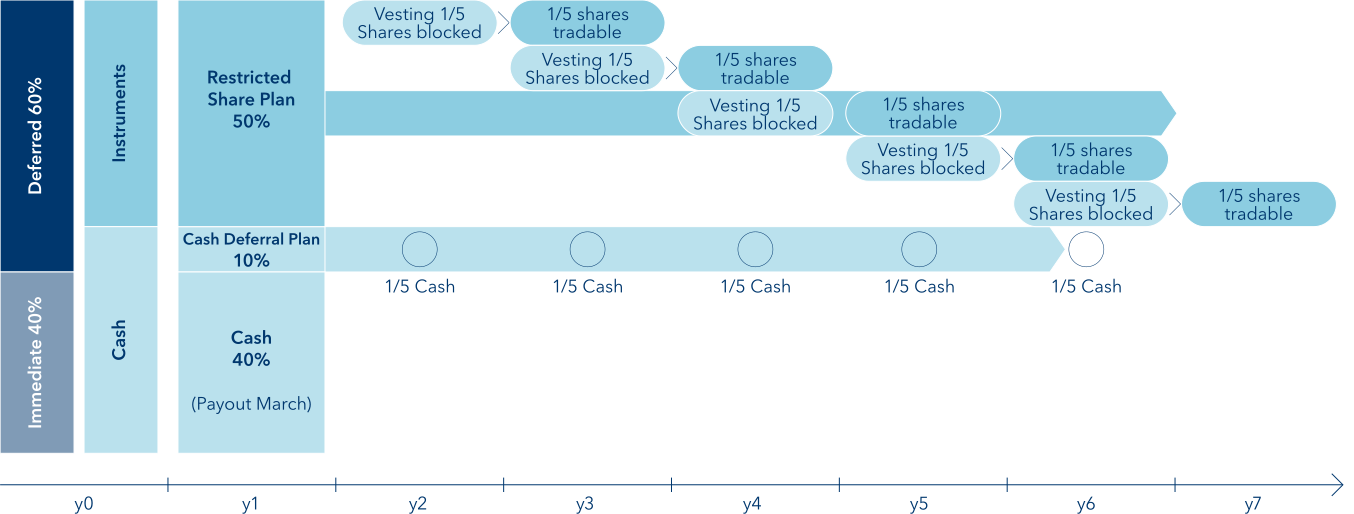
- Deferred compensation instruments: Using deferred compensation instruments, the long-term alignment of the interests of shareholders and employees is to be achieved by a participation of the employees in the growth in the value of the Group. VP Bank Group deploys risk-exposed equity-share- and cash plans as deferred compensation instruments. The deferred variable remuneration instruments are function- and person-dependent, but are also used for risk takers to comply with regulatory requirements and, in justified cases, on an individual basis to pay a deferred variable salary component, to implement special retention actions, to provide compensation for lost performance at the previous employer or to make any severance payments. Two instruments are used for this purpose: a Restricted Share Plan (RSP) and a Cash Deferral Plan (CDP). Under the RSP, one fifth of the total amount is paid out each year over the five-year plan period in the form of VP Bank registered shares A. After transfer, these remain blocked for a further year. Under the CDP, the cash distribution is spread linearly over five years.
Through the deployment of deferred compensation instruments, VP Bank Group complies with the legal regulations concerning payment schemes for risk takers, i.e. as a general rule, a minimum of 40 per cent of the variable compensation is granted in the form of deferred compensation instruments which are linked to a possible malus and/or claw-back rule and accordingly can be forfeited. The rules on deferred compensation instruments are set out in separate plan regulations.
VP Bank, under certain conditions, may withhold, reduce or cancel variable compensation components awarded to an employee (malus) or reclaim amounts which have already been paid (claw-back). This applies in particular in the event that employees are subsequently found to have been at fault or if disproportionately high risk is taken in order to increase corporate earnings. On leaving VP Bank, the relevant rules laid down by the Board of Directors in the regulations governing the compensation instruments apply.
The variable compensation component constitutes an additional voluntary benefit payable by VP Bank Group to which no legal entitlement exists, not even after repeated, unconditional payment thereof.
Equity-participation programme
Every year, employees are offered the chance to purchase VP Bank registered shares A on preferential terms. The number thereof depends in equal shares on the level of the fixed salary and the period of employment as of the measurement date, 1 May. The shares are subject to a sales restriction period of three years.
Fringe benefits
Fringe benefits are ancillary benefits which VP Bank offers its employees on a voluntary basis, often as a result of practices which are customary in the given location or business segment. In principle, the benefits are only of a minor amount. They are settled and reported in accordance with local regulations.
They include the following benefits in particular:
- Insurance benefits in excess of statutory provisions
- Retirement-benefit-related amounts, in particular voluntary employer contributions
- Preferential conditions for employees in the case of banking transactions, such as reduced-rate mortgages for an individual’s own home
- Further fringe benefits which are customary in the given location
Governance
Responsibilities
The Board of Directors of VP Bank is responsible for managing and structuring the compensation policy. Any change or adjustment to the compensation policy must be approved by the Board of Directors.
The Nomination & Compensation Committee (NCC) supports the Board of Directors with regard to all aspects relating to the compensation policy. In addition, each year, the NCC reviews the compensation policy regulations in order to ensure that they are up to date, compliant and appropriate. It also reviews the class of risk takers and monitors their remuneration. The NCC comprises the Members Philipp Elkuch (Chairman), Stephan Zimmermann, Stephan Ochsner and Katja Rosenplänter-Marxerf (see the Corporate governance chapter, section 3.5.2).
GEM is responsible for all aspects involving the implementation of compensation processes within the scope of the policy and lays down the framework thereof for the individual companies. It specifies the fixed and variable compensation of key managers, including the managers in charge of subsidiary companies. Furthermore, it issues annual implementing regulations to the companies and/or supervisors for the fixing of individual variable compensation.
The individual supervisors agree tasks and goals as part of the management by objectives (MbO) process and evaluate the achievement of goals at the end of the period. In addition to performance, particular attention is paid to the observance of all relevant regulatory provisions.
Group Executive Management | Chief Executive Officer | Nomination & Compensation Committee | Board of Directors | |
Compensation policy | Proposal | Review/request | Approval | |
Compensation of the Chairman of the Board of Directors | Request | Approval | ||
Compensation of the other Members of the Board of Directors | Request | Approval | ||
Total amount of variable compensation at VP Bank Group | Proposal | Review/request | Approval | |
Compensation of the Chief Executive Officer | Request | Approval | ||
Compensation of the other Members of the Executive Board | Proposal | Review/request | Approval | |
Compensation of the heads of Risk Management and Compliance | Proposal | Review/request | Approval | |
Compensation of other designated employees | Review/request | Approval | ||
Compensation of other employees | Approval |
Content and method of determining fixed and variable compensation
The compensation policy regulations as well as the risk policy regulations of VP Bank stipulate that the bank’s compensation systems and human resources management are to be designed in a manner that minimises personal conflicts of interest and behavioural risks.
With the budget, the Board of Directors approves the framework for the fixed compensation and, at the end of the year, decides on the level of provisions for variable salary components – taking the annual results into account.
The total amount of variable compensation is determined within a range known as the “value share” and is based primarily on the net profit of VP Bank Group. The Board of Directors conducts a facts-based assessment of the total amount of variable compensation and can adapt the amount. In times of adverse operating conditions, the overall amount of variable compensation is reduced accordingly based on the value-share approach and can even amount to zero. This takes into consideration the multi-annual, risk-adjusted profitability of VP Bank Group, which takes account of the sustainable level of profitability, capital costs and thus current and future risks.
The sum of provisions for variable compensation must be affordable in the aggregate. This should never result in VP Bank Group or any individual subsidiary company falling into financial difficulties. The impact on the Group’s equity situation is taken into consideration in this process.
Further to a request by the NCC (see the Corporate governance chapter, section 3.5.2), the Board of Directors establishes the principles applicable to compensation and the amount of compensation paid to the Board of Directors, as well as the fixed and variable compensation of the Members of GEM and the Heads of Risk Management and Compliance.
Allocation of variable compensation
The allocation of variable payments is made on a discretionary basis and in addition to the attainment of quantitative and/or qualitative goals also takes account of the degree of compliance with statutory requirements, guidelines set by the company, including the Code of Conduct, as well as any requirements defined by the client. Longer-term perspectives may also flow into the performance evaluation. The performance evaluation of identified employees is based upon the individual’s goals as well as the goals of the team, the business segment, the subsidiary company and the overall result of VP Bank Group on the basis of the value share approach. The variable compensation of employees in controlling functions, internal audit or with legal and compliance tasks is determined based upon the achievement of the targets related to their tasks irrespective of the results of the business units being controlled. A participation in the results of the company or of VP Bank Group is admissible within normal limits and is sensible within the spirit of equal treatment. Achievement of targets is evaluated after the end of the financial year within the scope of the performance-management process. The amount of the individual variable compensation is determined by the employee’s superior.
Compliance with compensation provisions
The compensation practices of VP Bank are in compliance with the Liechtenstein Banking Act as well as the EU Directive and are geared to long-term success. The decision concerning the earmarking of a total amount for compensation ultimately lies with the Board of Directors.
VP Bank does not make guaranteed payments in addition to fixed salaries such as end-of-service indemnities agreed in advance. Special payments upon commencement of employment may occur in given individual cases – as a rule, these relate to compensation for foregone benefits from the previous employer.
In application of Liechtenstein law, variable salary components, where applicable, may be cancelled, those withheld may be forfeited or those already paid out may be reclaimed. This applies in particular in the event that employees are found to have been at fault or excessive risk is assumed to achieve goals.
Compensation, shareholdings and loans to selected groups of persons
Board of Directors
The Board of Directors receives compensation for the duties and responsibilities conferred on them by law and pursuant to Art. 20 of the Articles of Association. This is laid down annually by the Board of Directors in plenary session acting on the proposal of the NCC. Compensation is paid to the Members of the Board of Directors on a graduated basis according to their function on the Board of Directors and its committees or in other bodies. Three quarters of this compensation is paid in cash and one quarter is settled in the form of freely disposable VP Bank registered shares A, the number of which is determined by the current market price at the time of receipt.


Compensation paid to the Members of the Board of Directors (audited)
Remuneration1, 2 | Total remuneration | ||||||||
Fixed | thereof in registered shares A (market value) | Retirement Benefit plans | |||||||
in CHF 1000 | 2025 | 2024 | 2025 | 2024 | 2025 | 2024 | 2025 | 2024 | |
Board of Directors | |||||||||
Stephan Zimmermann | ChairmanA | 525 | 373 | 131 | 93 | 525 | 373 | ||
Dr. Thomas R. Meier | ChairmanB | 163 | 41 | 163 | |||||
Ursula Lang | Vice ChairwomanC | 70 | 180 | 18 | 45 | 70 | 180 | ||
Dr. Mauro Pedrazzini | Vice ChairmanD | 160 | 160 | 40 | 40 | 160 | 160 | ||
Stefan Amstad | BoDE | 160 | 160 | 40 | 40 | 160 | 160 | ||
Philipp Elkuch | BoDF | 160 | 160 | 40 | 40 | 160 | 160 | ||
Dr. Beat Graf | BoDG | 47 | 145 | 12 | 36 | 47 | 145 | ||
Dr. Dirk Klee | BoDH | 47 | 47 | ||||||
Dr. Stephan Ochsner | BoDI | 93 | 23 | 93 | |||||
Barbara Ofner | BoDH | 107 | 27 | 107 | |||||
Katja Rosenplänter-Marxer | BoDI | 160 | 150 | 40 | 38 | 160 | 150 | ||
Total Board of Directors | 1,482 | 1,538 | 371 | 373 | 0 | 0 | 1,482 | 1,538 | |
AChairman of the Board of Directors since 26. April 2026 (previously member), Chairman of the Strategy & Digitalisation Committee since 26. April 2024 (previously member), member of the Audit Committee until 26. April 2024, Member if the Nomination & Compensation Committee since 26. April 2024
BChairman of the Board of Directors until 26. April 2024
CMember of the Board of Directors until 25 April 2025, Chairwoman of the Risk Committee (until 25 April 2025), Member of the Nomination & Compensation Committee (until 25 April 2025), Member of the Audit Committee ( since 1. October 2024 until 25 April 2025)
DMember of the Strategy & Digitalisation Committee, Member of the Risk Committee
EChairman Audit Committee, Member of the Risk Committee
FChairman Nomination & Compensation Committee, Member of the Strategy & Digitalisation Committee
GMember of the Board of Directors until 25. April 2025, Member of the Audit Committee, Nomination & Compensation Committee until 25. April 2025
HMember of the Board of Directors since 26. April 2024 until 30. September 2024, Member of the Strategy & Digitalisation Committee and of the Audit Committee (during the period mentioned)
IMember of the Board of Directors since 25. April 2025, Member of the des Nominaton & Compensation Committee (since 25. April 2025), Member of the des Audit Committee (since 25. April 2025)
JMember of the Board of Directors since 25. April 2025, Vorsitzende des Risk Committee (since 25. April 2025), Member of the des Audit Committee (since 25. April 2025)
KMember of the Risk Committee, Member of the Nomination & Compensation Committee (since 25. April 2025), Nachhaltigkeitsbeauftragte Board of Directors
1Social-security costs on the emoluments paid to the Board members are borne by VP Bank.
2Compensation for out-of-pocket expenses is not included.
VP Bank has concluded no agreements on severance payments with Members of the Board of Directors.
Shareholdings and loans to the Members of the Board of Directors and related persons (audited)
Shareholdings in VP Bank | Loans and credits | |||||
Number of Shares (including related parties, excluding qualifying participants) | ||||||
in CHF 1000 | Registered shares A | Registered shares B | ||||
2025 | 2024 | 2025 | 2024 | 2025 | 2,024 | |
Board of Directors | ||||||
Stephan Zimmermann | 3,159 | 1,542 | ||||
Stefan Amstad | 1,354 | 861 | ||||
Philipp Elkuch | 2,165 | 1,672 | 2,220 | 2,220 | ||
Dr. Beat GrafA | 3,443 | |||||
Ursula LangA | 3,355 | |||||
Dr. Stephan OchsnerB | 288 | |||||
Barbara OfnerB | 329 | |||||
Dr. Mauro Pedrazzini | 1,757 | 1,264 | ||||
Katja Rosenplänter-Marxer | 2,361 | 1,868 | ||||
Total Board of Directors | 11,413 | 14,005 | 0 | 0 | 2,220 | 2,220 |
AMember of the Board of Directors until 25 April 2025
BMember of the Board of Directors since 25 April 2025


Group Executive Management (GEM)
A target total remuneration package is defined for each member of Group Executive Management based on their role and market practices. It consists of a fixed base salary and variable target remuneration:
The base salary is contractually agreed between the board and the individual members of the Board of Directors. In addition to the base salary, VP Bank pays pro rata contributions to the management insurance scheme and the pension fund.
The Board of Directors sets the planning parameters for variable target compensation on an annual basis. The amount allocated is based on a bonus-malus principle, i.e., members receive more or less than the target compensation if the annual targets are exceeded or not achieved. The maximum potential is 150 per cent of the variable target compensation and the minimum is 50 per cent, although this can also be reduced to zero. The annual allocation is made by the board, taking into account the Group's performance (net profit of VP Bank Group for determining the total bonus pool), the implementation of the strategy, and the achievement of individual targets.
In accordance with the model approved by the Board of Directors on 26 October 2023, the payout for the variable compensation consists of the following components:
- A fixed base salary; this is contractually agreed between the Board of Directors and individual Members. In addition to the base salary, VP Bank pays proportionate contributions to the management insurance scheme and the pension fund.
- A Restricted Share Plan (RSP); this is a long-term, variable management equity-participation programme in the form of registered shares A of VP Bank Ltd. It promotes long-term commitment in the form of equity shares. The RSP is paid out over the five-year plan period in five equal installments per year in the form of VP Bank registered shares A. Once the equity shares have been transferred, they remain blocked for one year. Until the time of transfer of ownership, the Board of Directors reserves the right to reduce or suspend the allocated vested benefits in the case of defined occurrences and in extraordinary situations. The share of the RSP makes up 50 per cent of total variable performance-related compensation.
- A Cash Deferral Plan (CDP); this is a long-term management equity-participation programme in the form of cash payments. Payment is spread out pro rata over five years. Until the time when each respective payment is made, the Board of Directors reserves the right to reduce or suspend the cash benefits allocated in the case of defined occurrences and in extraordinary situations. The share of the cash deferral makes up 10 per cent of total variable performance-related compensation.
- Direct cash compensation, the Short Term Incentive Plan (STI), the share of which amounts to 40 per cent of total variable performance-related compensation.
VP Bank has concluded no agreements on severance pay with the Members of GEM. An external advisor who has no other mandates from VP Bank Group was commissioned to structure the compensation model.
Compensation 2025
Compensation paid to GEM (audited)
Remuneration1, 2 | Total remuneration | |||||||||||
Fixes basic salary | Short Term Incentive (STI) | Cash Deferral Plan (CDP) | Restricted Share Plan (RSP) | Retirement Benefit plans | ||||||||
in CHF 1000 | 2025 | 2024 | 2025 | 2024 | 2025 | 2024 | 2025 | 2024 | 2025 | 2024 | 2025 | 2024 |
Group Executive Management | 3,066 | 3,289 | 856 | 600 | 214 | 0 | 1,070 | 0 | 383 | 664 | 5,590 | 4,663 |
Highest remuneration | ||||||||||||
Dr. Urs Monstein | 700 | 320 | 80 | 400 | 101 | 1,601 | ||||||
Paul H. Arni | 200 | 600 | 0 | 0 | 245 | 1,045 | ||||||
1These amounts do not include fees or lump-sum allowances.
2Length of service awards and any severance payments are included.
Following the Group Executive Management’s decision to waive variable compensation for 2024, an allocation of CHF 2.14 million will be made for 2025 in addition to the base salary of CHF 3.07 million. As described above, 40% (CHF 0.86 million) will be paid out immediately, while the remaining 60% (CHF 1.28 million) will be deferred. Of the deferred variable compensation, CHF 1.07 million will be allocated in the form of shares under the Restricted Share Plan (RSP), and CHF 0.21 million will be allocated in cash under the Cash Deferral Plan (CDP).
Deferred compensation from previous years
The following payments were made to the Members of GEM in the 2025 financial year for variable deferred compensation from previous years.
The third tranche of CHF 48,600 was paid out from CDP 2022–2026, the second tranche of CHF 45,250 from CDP 2023–2027 and the first tranche of CHF 21,700 from CDP 2024–2028.
A total of 3,044 performance shares with a market value of CHF CHF 252,043 on the date of allocation were transferred to the Members of GEM from PSP 2022–2024, which was part of the compensation for the 2020 financial year. The vesting multiple applied was 60 per cent.
The vested benefits from previous management equity-participation programmes (PSP 2023–2025, PSP 2024–2028, PSP 2025–2030, CDP 2023–2026, CDP 2023–2027 and CDP 2024–2028) will continue to run unchanged until the end of the plan period. The following table, “Outstanding management equity-participation programmes”, shows an overview of outstanding rights to deferred variable compensation from previous financial years for the Members of GEM in post on 31 December 2025.
Outstanding management equity-participation programmes
Performance shares | Shares (vesting) | ||||
Performance Share Plan | Vesting date | Number | Value | Number | Value |
PSP 2023–2025 | 01.03.2026 | 5,165 | 452,506 | To be determined | To be determined |
PSP 2024–2028 | 01.03.2029 | 6,387 | 542,576 | To be determined | To be determined |
Vesting date | Restricted Shares | Outstanding | |||
Performance Share Plan | First | Last | Value | Number | Value |
PSP 2024–2028 | 01.03.2026 | 01.03.2030 | 1,357 | 100052 | 1357 |
Vesting date | Value on vesting date | Value | |||
Cash Deferral Plan | First | Last | Annually | Total | Outstanding |
CDP 2022–2026 | 01.03.2024 | 01.03.2027 | 48,600 | 243,000 | 97,200 |
CDP 2023–2027 | 01.03.2025 | 01.03.2028 | 45,250 | 226,250 | 135,750 |
CDP 2024-2029 | 01.03.2025 | 01.03.2029 | 21,700 | 108,500 | 86,800 |
Overview of outstanding allocations of deferred compensation (to the Members of Group Executive Management in post on 31 December 2025)
Shareholdings and loans to Group Executive Management and related persons (audited)
Shareholdings in VP Bank | Loans and credits | |||||
Number of Shares (including related parties, excluding qualifying participants) | ||||||
Registered shares A | Registered shares B | |||||
in CHF 1000 | 2025 | 2024 | 2025 | 2024 | 2025 | 2024 |
Management | ||||||
Dr. Urs Monstein, CEO | 9,036 | 8,410 | 2,614 | 2,614 | ||
Roger Barmettler, CFOA | 884 | 672 | ||||
Roland Kläy, CFOB | 890 | |||||
Patrick Bont, CRO | 1,129 | 177 | ||||
Dr. Felix BrillC | 3,000 | 1,809 | ||||
Dr. Mara HarveyA | 745 | |||||
Adrian Schneider | 220 | 220 | 1,870 | |||
Dr. Rolf Steiner | ||||||
Total Management | 13,385 | 9,691 | 0 | 0 | 7,183 | 4,031 |
AMember of the Group Executive Management until 31 December 2024
BMember of the Group Executive Management since 1 October 2025
CMember of the Group Executive Management since 1 January 2025