ESRS S4 Consumers and end-users
Interests and views of stakeholders (SBM-2)
The clients of VP Bank, i.e. consumers and end-users, are the focus of the bank’s activities. Client trust is of central importance. VP Bank acquires this trust through active exchanges of information, a responsible approach to client funds and transparent communication and pricing. Essential building blocks for this are the bank’s structured investment process, built on its goal-based advisory model, and ensuring affordability in the lending business.
Management conducts one-on-one conversations with clients to ensure that their feedback is taken into account directly and integrated into the strategy and business model. In addition, client surveys are carried out, the results of which are communicated to management and the Board of Directors. When developing new products, the opinion of clients is taken into account by involving test clients.
Material impacts, risks and opportunities and their interaction with strategy and business model (SBM-3)
As a result of the bank’s business model, its clients can be divided into two main categories: (i) intermediaries and (ii) private clients. Intermediaries are mainly external asset managers, trustees and family offices, which can be classified themselves as professional financial market participants and are therefore subject to a different level of investor protection than private clients. The IROs identified in relation to the bank’s clients primarily result from working with private clients and relate to aspects of information quality and transparency, affordability in lending and incorrect sales of financial products.
Client trust is one of the decisive factors in the long-term success of VP Bank and at the same time forms the basis for the Bank’s growth strategy. The suitability check for wealth management and advisory mandates as well as the affordability check in the mortgage business are the most important building blocks in terms of reducing negative impacts on the bank’s clients and thus further strengthening trust in VP Bank.
Policies related to consumers and end-users (S4-1)
Financing
The credit regulations are the top governance document in the lending business and apply to the whole of VP Bank. They stipulate that sustainability criteria and standards should be incorporated in particular when assessing the creditworthiness and the intrinsic value of collateral. The Board of Directors of VP Bank is responsible for the adoption of these regulations. The aim is to ensure the protection of the borrower.
Affordability calculation
In addition to real estate valuation, the affordability calculation is the most important quantitative decision-making basis in the granting of mortgage loans. The assessment of long-term solvency (affordability) must therefore be carefully carried out and documented in a comprehensible manner. The purpose of calculating affordability is to estimate the borrower’s ability to repay interest and capital and to afford the normal maintenance of the real estate. Affordability must be calculated on the basis of the borrower’s future income and financing costs. For the affordability calculation of each booking location, the local conditions and regulatory provisions must be taken into account. The following minimum standards generally apply:
- Permanent income is defined as the most likely future annual income, derived from the borrower’s past income, which can most likely continue to be achieved under normal circumstances, taking into account all known circumstances.
- The financing costs must cover the interest and repayment of the loan, the maintenance costs of the real estate and all other fixed costs. The financing costs must also include interest and repayment on all other credit facilities of the borrower.
- If the principal debtor is a private individual who still has ten or fewer years before retirement, the affordability on retirement must also be calculated. Risk mitigating measures may need to be taken (e.g. higher repayment amounts, review of financing on retirement, etc.)
Gaps in the affordability
Real estate financing for borrowers with gaps in affordability is marked accordingly in the bank’s internal system. The competent lending authority may approve the affordability gaps in real estate financing by (a) accepting pledged or blocked cash deposits and other liquid funds to cover the calculated affordability gap for 12 months or longer or (b) an unconditional total guarantee to cover the affordability gap for 12 months or longer. If the affordability gap is closed in this way, the corresponding marking will not be set or removed.
Investing
The integration of sustainability criteria into the investment and advisory process is governed by the corresponding guidelines of VP Bank, in particular in the Responsible Investment Policy. Sustainability is also integrated into general monitoring and compliance systems and processes at the portfolio level. Various committees are responsible for the development and approval of the sustainable investment approach, suitability criteria and strategies: the Investment Strategy Committee, the Investment Tactics Committee and the Product & Pricing Committee. The departments responsible for capital investments – Compliance, Internal Auditors and Group Executive Management – are responsible for the implementation of this directive within the scope of their respective duties. A detailed list of directives, including responsibilities, can be found in chapter ESRS 2 MDR-P.
The overall strategy for managing the material impacts on consumers and end-users as well as the associated material risks and opportunities of investment products is based on five pillars. The aim is to ensure investor protection when advising clients and providing financial services in general.
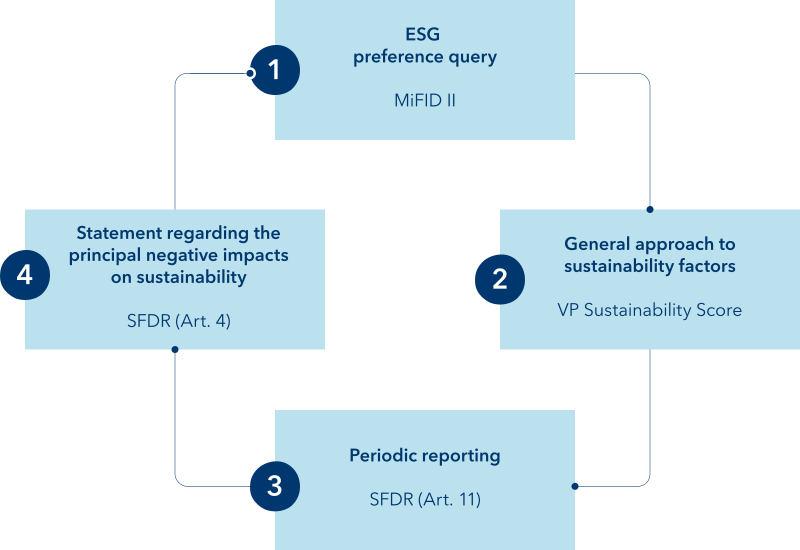
The five-pillar approach takes into account the suitability requirements of MiFID II, the SFDR disclosure requirements and the guidelines of the Swiss Bankers Association (SBA) on the inclusion of ESG preferences and ESG risks. As a result, potential negative impacts on the bank’s clients due to non-compliance with regulatory requirements, incorrect sales of financial products and greenwashing are actively managed.
1. Target market classification
Among other things, the revised Markets in Financial Instruments Directive 2014/65/EU (MiFID II) provides for additional investor protection measures. Existing categories (client category, knowledge and experience, financial situation, risk tolerance and objectives and needs) have been supplemented by information on sustainability-related objectives and sustainability factors. As part of the target market test, VP Bank takes these criteria into account. In principle, the manufacturer information is used for third-party products. For own products, the definition is implemented as part of the New Product Process.
The bank’s investment advisers ask clients about their sustainability preferences to recommend products that match them. The sustainability preferences complement the previous investment objectives which have already been taken into account in the suitability assessment.
2. Pre-contractual information
In the pre-contractual information in accordance with SFDR (EU/2019/2088), VP Bank discloses how sustainability risks are included in investment decisions, whether the respective wealth management mandate is aimed at environmental and/or social characteristics and how high the proportion of sustainable and taxonomy-compliant investments is. On this basis, VP Bank ensures that the product-specific sustainability aspects are compatible with client preferences.
3. General approach to sustainability factors in investment decisions
VP Bank applies a combination of approaches to reduce the material negative impact of investment decisions on sustainability factors and to promote the positive aspects. The most important methods are restrictions, improvements and a focus on the United Nations Sustainable Development Goals (UN SDGs). The basis for implementation is provided by the VP Bank Sustainability Score (VPSS). The VPSS method is based on third-party data but goes beyond a traditional ESG rating. VP Bank limits investments with unacceptable negative impacts (see table below). In addition, investments must meet minimum criteria in the following three areas: ESG rating, business activity and business practices. Investments that do not meet the minimum criteria are not included in the investment universe.
VP Bank has applied the VPSS, including various minimum requirements, to discretionary wealth management, investment advisory services, own funds of VP Bank and on-balance-sheet proprietary investments. These criteria are recorded in the corresponding investment, portfolio management and advisory systems and processes. The recommendations are continuously monitored for compliance with the criteria. If an investment is no longer suitable, it is no longer recommended. If such investments are included in existing portfolios, clients are informed and alternatives are proposed. In the case of discretionary wealth management mandates, financial instruments that are no longer suitable will be sold within a certain period of time.
The following table summarises the main methods to mitigate negative impacts from the bank’s investment activity:
IRO focus | Basis | Motivation | Implementation |
Risk | ESG Rating | We reduce ESG risks in our portfolios by avoiding companies with low ESG ratings. | A third-party provider's data is used for the ESG rating. The ratings range from AAA (best rating) to CCC (worst rating). The two lowest ratings, B and CCC, are excluded from our investment universe. For third-party and exchange-traded funds, we require a minimum level of coverage by the data provider and only allow a limited number of B- and CCC-rated investments. The permissible thresholds depend on the region, its economic structure and its level of maturity . |
Risk | Business practices | We avoid companies with business practices that are illegal or violate international standards. | Business practices relate to the way companies conduct themselves. VP Bank adheres to three internationally recognised standards: the UN Global Compact, the UN Guiding Principles on Business and Human Rights and the International Labour Organization (ILO) Labour Standards. We exclude equities and bonds of companies that violate these international standards or have been identified to be subject to a ‘very severe’ controversy. For third-party fund and ETF recommendations, the proportion of investments with violations of international standards and ‘very serious’ controversies may be very low. |
Risk | Business activities | We have defined minimum ethical standards that determine the areas in which the companies in which we invest should not be active. | The business activity relates to the products and services offered by a company. The critical business areas are defined as tobacco, gambling, thermal coal, nuclear power and controversial weapons. We exclude companies that generate more than a defined threshold of their revenues from these critical business areas. Third-party funds and ETFs may contain a very small proportion of companies that operate in areas classified as critical. |
Opportunities | ESG momentum | We finance the transition to a more sustainable future by investing in companies that demonstrate continuous improvement in their ESG performance. | This component of the VPSS measures the extent to which and direction in which the ESG rating has changed. We favour companies, governments or sovereign debtors that improve their ESG rating and penalise those that experience a downgrade. The momentum score can positively or negatively influence the overall score, but does not lead to exclusion. |
Impact | Sustainable Development Goals (SDG) | We prioritise companies that have a positive impact on the environment and society by contributing to one or more of the Sustainable Development Goals (SDGs). | The SDG-Score analyses a company's products and activities in relation to the 17 UN Sustainable Development Goals (SDGs) and measures the extent to which they contribute to or conflict with the achievement of these goals. The SDG-Score can positively or negatively influence the overall score, but does not lead to exclusion. |
4. Periodic reporting
For products or mandates covered by Art. 8 or 9 SFDR, compliance with environmental and social aspects is reported annually. A portfolio-specific report is prepared periodically for clients with a corresponding wealth management mandate and made available directly. The disclosure is intended to increase transparency and provide investors with valuable information on the sustainability commitment and the material impacts and risks of the funds in which they are invested and the discretionary wealth management mandates. This also closes the circle in terms of an initial survey of client preferences, the subsequent recommendation of needs-based products and, finally, proof of compliance with pre-contractual targets by means of periodic reporting.
5. Statement regarding the principal adverse impacts on sustainability (PAI statement)
Investment decisions and investment advisory services can have negative impacts on, contribute to or be directly linked to sustainability factors. For this reason, VP Bank reports annually on how the negative impacts of investment decisions on sustainability factors at company level is taken into account and how this manifests itself specifically at company level in the aggregate of all relevant discretionary wealth management mandates and the bank’s own funds.
A negative sustainability impact refers to the negative impacts that an investment decision may have on the environment or society. This includes aspects such as greenhouse gas emissions, biodiversity, water, waste and social/employee matters that may be relevant to investments in companies, countries, supranational companies and real estate. The selection of the most important negative impacts considered by the investment team of VP Bank must be relevant to their investment philosophy and exposures. VP Bank is convinced that taking sustainability factors into account leads to better investment results. VP Bank considers sustainability criteria in its portfolio solutions, building blocks and product selection.
Processes for engaging with consumers and end-users about impacts (S4-2)
VP Bank provides its clients with various forms of advisory standards to inform them of impacts. During the transition phase, higher contact frequencies, including participation in events, are possible. The contact points with consumers and end-users are documented by the client advisors of VP Bank in the RM Cockpit. The client advisor always records the form of engagement in the RM Cockpit (dashboard for client advisors). This enables an evaluation per consumer or end-user, which makes engagement measurable in terms of the impacts of the business relationship.
Process: engaging with consumers and end-users
The client advisor engages with consumers and end-users about impacts via various forms of contact. This results in the following process:
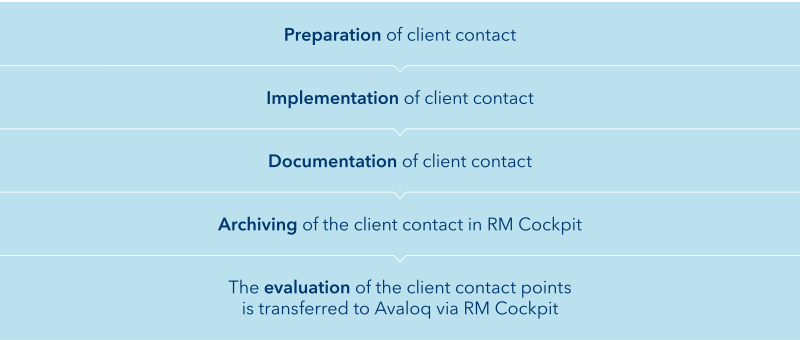
The choice of support concept for engaging with consumers
1. Scope of support
The overview corresponds to the target image. In the transition phase or when there is potential, higher contact frequencies, including event participation, may be useful and required.
High-net-worth individual | Affluent | Staff | |||
Local | International | Local | International | ||
Visits per year | 1 | 1 | 1 | No preference | No preference |
Phone calls per year | 2 | 2 | 1 | 1 | No preference1 |
Investment ideas | Client request | Client request | Client request | Client request | Client request |
1Ongoing review of the potential of the retail portfolio with «separate» measures based on it.
2. Depending on the service purchased
Wealth management mandates | VP Bank Advice Premium | VP Bank Advice Comfort | VP Bank Advice Basic | |
Visits per year | 1+ | 1 to 3 | 1 to 2 | No specification |
Telephone calls per year | Client request | Monthly | Around 4 | No specification |
Accountability – processes for engaging with consumers and end-users about impacts
Contact persons by location
Location | Contact |
Liechtenstein | Head of Region Liechtenstein & BVI |
Zurich | Head of Region Europe |
Luxembourg | Head of Region Europe |
Singapore | Chief Executive Officer Asia |
Hong Kong | Chief Executive Officer Asia |
British Virgin Islands | Head of Region Liechtenstein & BVI |
Funds Solutions | Project Manager |
Evaluation – processes for engaging with consumers and end-users about impacts
Client advisors use various forms of contact to engage with clients and record these as “touch point entries” in the core banking system. These forms of contact are summarised for the evaluation of the number of client contacts. This sum gives the absolute number of client contacts. The ratio between all client contacts per location and client segment and the number of end clients shows the average number of contact points in the reporting period.
The evaluation of the figures is based on the reporting date and reflects the contacts of client advisors with clients who were actively booked with VP Bank on 31 December 2024. When it comes to institutional clients, the denominator refers to the number of end clients. An individual evaluation of client contacts does not take place. The effectiveness of the cooperation is therefore not assessed. It is the responsibility of the client advisors to assess the effectiveness of the cooperation individually. In addition, location- and client-advisor-specific effects can occur, resulting in differences in average values.
For the 2024 financial year, the average number of client contacts per year for VP Bank was as follows:
Locations1 | Private Banking | Institutionel clients2 |
Liechtenstein | 6.0 | 0.9 |
Switzerland | 5.5 | 0.5 |
Luxemburg | 6.6 | 10.4 |
Singapore | 27.7 | 11.3 |
British Virgin Island | 2.0 | - |
1Due to the closure of the Hong Kong office during the year, existing customers were reallocated to other booking centers and are therefore not shown separately.
2Institutional clients include business with external asset managers and trustees.
Processes to remediate negative impacts and channels for consumers and end-users to raise concerns (S4-3)
VP Bank offers external stakeholders various channels through which they can raise their concerns. The client feedback management applied by VP Bank distinguishes between feedback and complaints. Client statements can be received either directly via a client advisor or via other channels such as the contact form on the website or public e-mail addresses. In any case, the statements will be immediately forwarded to the responsible client advisor for processing. In the event of a negative statement regarding the client advisor, this will be forwarded to the line manager for processing.
Complaints management: process steps and classification of client feedback management
This triage between feedback and complaints is required to deal with the client’s statement.
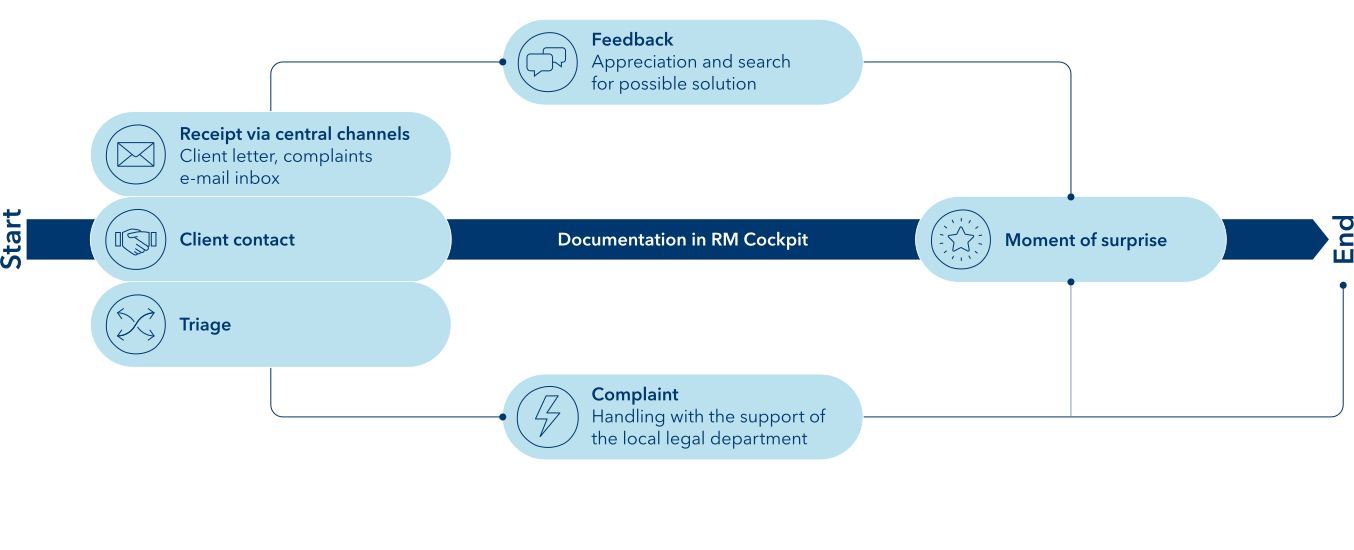
Classification of definitions and processing of statements
Definition of complaint
- Confrontation
- Unacceptable
A complaint is a statement by a client about a situation that is considered unacceptable. The client expects a prompt remedy to the situation or an individual solution. As a general rule, the client advisor is responsible for processing the complaint and communicating with the client. If the complaint is directed against the client advisor, the responsible line manager must be consulted. To ensure that the processing of complaints complies with local regulatory requirements, the local legal department of VP Bank is involved.
Definition of feedback
- Conversation
- Acceptable
The client expresses a personal opinion on products, services, behaviour or communications but does not expect an immediate adjustment to the situation or individual solution. If there is an existing solution or alternative to the problem, it is suggested to the client and implemented accordingly. If there is no suitable solution at this point, the process for finding a solution is considered complete for the time being.
Systematic recording of client statements
All client statements, whether feedback or complaints, positive or negative, must be recorded in the dedicated application (client journal entry). Client statements received directly by VP Bank will be treated as strictly confidential. Data protection and the protection of the privacy of the person making the statement are of central importance. However, these may vary depending on the channel chosen (see Channels to express opinions).
Involvement of other departments
Additional specialist departments may be consulted in certain cases that cannot be handled by the relevant client advisor or line manager. Examples include the following (list is not exhaustive):
- Corporate Communications
- Group Legal Services
- Group Information Security
- Group Product & Service Center
Internal reports: processing of client statements
Based on the client statements recorded by the client advisor in the dedicated application (client journal entry), reports of this client feedback (positive and negative) are sent to Group Executive Management and the relevant divisions on a quarterly basis. In specific cases, recommendations for action are given, which are processed by the relevant specialist departments.
Channels to express opinions
VP Bank has its own and external channels where external stakeholders can express their opinions. These are as follows:
VP Bank’s own channels (for the direct collection of client comments, including proactive processing by an internal team of experts) | External channels |
|
|
*These channels can be used anonymously.
The channels listed are available not only to clients, but also other stakeholder groups such as suppliers. This does not apply to the channels “personal contact with client advisors”, “messages via the client portal” and “client satisfaction survey”, which are reserved for clients of VP Bank. In addition to the legal requirements, VP Bank is also guided in its complaints management by the best practices of its peers. VP Bank also has a team of professionals who are familiar with usability, user experience and the maintenance of social media channels and who undergo further training in these areas on an ongoing basis. All channels are managed in accordance with the applicable data protection regulations. The existing processes are reviewed by process management, while the Client Experience department also reviews these processes on a quarterly basis. With the contact forms, the complaints e-mail address and the local ombudsman’s offices, VP Bank complies with the local legal requirements. These may differ slightly depending on the location.
Anonymity and the protection of personal and confidential information are the top priorities for VP Bank. It is therefore also possible to complete the complaint form or contact form for client feedback anonymously.
Effectiveness and trustworthiness of the existing channels
VP Bank proprietary channels are monitored and evaluated on an ongoing basis. The focus is also on the availability and awareness of the selected channels, and they comply as a minimum with local regulations (reference to client feedback form, local ombudsman’s offices). Internal evaluations of the proprietary channels, such as the number of users of the website, including the forms sent, the e-banking messaging tool and calls in the Client Service Center, show that the channels used are known to internal and external stakeholder groups, are deemed to be trustworthy and are used, in particular the client feedback sub-site and the dedicated complaint form.
User numbers for feedback channels
User numbers distributed across the various feedback channels.
Client feedback forms sent via web form
Forms | Number (2024) |
International complaint form | 7 |
Hong Kong complaint form | 0 |
Number of users of e-banking messaging tool
Number | |
Business unit | 2024 |
VP Bank (BVI) Ltd | 51 |
VP Bank Ltd | 2,400 |
VP Bank (Luxembourg) SA | 205 |
VP Bank (Switzerland) Ltd | 768 |
VP Bank Ltd Singapore Branch | 10 |
*Evaluation of the number of users who used the messaging tool in e-banking in 2024 (i.e. sent at least one message)
Calls via VP Bank Client Service Center (only MS Teams 2024)
Business unit | Number | Incoming calls received |
VP Bank (BVI) Ltd | Main number (+1 284 494 1100) | 1,261 |
e-banking (+1 284 494 1100) | Included in main number | |
VP Bank Ltd | Main number (+423 235 66 55) | 12,557 |
e-banking (+423 235 64 64) | 4,286 | |
VP Fund Solutions (Liechtenstein) AG | Main number (+423 235 67 67) | 177 |
VP Bank (Luxembourg) SA | Main number (+352 404 770-1) | 504 |
e-banking (+352 404 770 555) | 22 | |
VP Fund Solutions (Luxembourg) SA | Main number (+352 404 770-297) | 232 |
VP Bank (Switzerland) Ltd | Main number (+41 44 226 24 24) | 932 |
e-banking (+41 44 226 25 65) | 118 | |
VP Bank Ltd Singapore Branch | Main number (+65 6305 0050) | 1,043 |
e-banking (+65 6305 0050) | Included in main number | |
VP Wealth Management (Hong Kong) Ltd | Main number (+852 3628 99 00) | Evaluation via MS Teams is not possible |
VP Bank Ltd, Hong Kong representative office | Main number (+852 3628 99 99) | Evaluation via MS Teams is not possible |
Taking action on material impacts on consumers and end-users, and approaches to managing material risks and pursuing material opportunities related to consumers and end-users, and effectiveness of those actions (S4-4)
Products
The introduction of balance sheet products incorporates environmental, social and governance (ESG) criteria into the New Product Process. ESG criteria are also taken into account in the case of suspensions and product adjustments in accordance with the New Product Process. The New Product Process includes pre-evaluation, implementation and half-year reviews.
The classification and assessment matrix (Sustainability Matrix, ESG criteria) for balance sheet products is part of the New Product Process. The ESG matrix ensures consideration in the end-to-end process.
The Product & Pricing Committee reviews and decides on applications received and processed. This is done periodically and at least quarterly. Extraordinary decisions may be made in addition to the regular times, including outside the usual deadlines, by means of a circular resolution. The Product & Pricing Committee is composed of the following: GPC (Chair, without voting right); regions (Europe, Asia, LI, BVI); functions (COO, CRO, GPO); and, optionally, Members of the Board of Directors (CIO, GTR, CRU). The effectiveness of and possible non-compliance with the ESG criteria are tracked and evaluated in a review according to the classification or assessment matrix in the product launch, including adjustments and suspensions (e.g. VP Bank Sustainability Score). From this, recommendations with targeted measures can be submitted to the Product & Pricing Committee. Depending on whether they are allocated to basic services, financing, investing, other services or digital assets, the review frequency for existing products is every year or every three years. The review intervals are derived from the risk-based scoring model. Scoring is calculated based on the seven risk types of earnings and cost situation, market trends, law, IT/process, external partners, cross-border and reputation. In the case of more than three matches, the products or product groups are subjected to the annual review. Documentation of processes and competencies is described in the Group Standard “GS-19, Product Development, Management and Pricing”.
Investing
Negative impact indicators are treated differently by VP Bank regardless of their importance. The most stringent measure is exclusion: investments that violate this indication may not be recommended by analysts or by client advisors. Wealth management mandates managed by the bank, as well as the bank’s own funds, must not be invested in assets that are excluded. This applies irrespective of the investor’s sustainability preferences. The basis for this is the VP Bank Sustainability Score (VPSS) described above. In addition to negative impact indicators, the VPSS also maps those with a positive impact. For example, enterprises with an above-average ESG rating in their sector get a higher VPSS. This also applies to enterprises with impeccable business practices or those that make a positive contribution to one or more of the UN Sustainable Development Goals (UN SDGs).
More stringent requirements have been defined for clients with the “important” or “essential” sustainability preferences. Irrespective of clients, this also applies to in-house wealth management and the bank’s own investment funds. For the financial instruments used for this purpose, it is no longer sufficient to simply not show an exclusion; they must also have higher minimum requirements, which in turn are measured by the VPSS. In addition, the weighted portfolio value must be above the respective threshold value. The basis for this is again the VPSS. In addition to the exclusion criteria listed above, this also takes into account a penalty for a below-average ESG rating, controversies or borderline business activities such as nuclear energy, pornography, small arms, genetically modified organisms (GMOs), oil sands, for-profit prisons and fur.
In addition, the aim was to have a positive effect by adding targeted asset classes that are expected to have a positive impact on society and the real economy. These include microfinance bonds that are used in the Sustainable Plus mandates. This wealth management solution also uses green and social bonds within corporate and government bonds. The coverage varies depending on the reference currency and market liquidity. The bond selection lists for advisory clients indicate whether the bond is a green or a social bond. Insurance-linked securities are also used for all clients with a mixed investment strategy, regardless of their sustainability preference.
The portfolio solutions for investors with the highest sustainability preference take into account a minimum proportion of investments that are considered sustainable within the meaning of the Disclosure Regulation. This also applies to taxonomy-compliant investments.
Measures have been taken to meet client demand for sustainable investments. These relate to both processes and products. The latter should also increase interest in sustainable investing. Sustainability factors were integrated into the investment and advisory process as part of the “Investing for Change” strategic initiative. The product developments launched since then have been designed to take the topic of sustainability into account in line with the bank’s philosophy. These include:
- Sustainable Plus mandate and advisory package (2021): wealth management and advisory solution for investors with high sustainability preferences, investment strategy for the “Conservative”, “Balanced” and “Growth” risk profiles
- In 2024, the “Equity” and “Fixed Income” risk profiles were added to the product range.
- Fund line for the Sustainable Plus mandate and advisory package (2022): based on the existing strategies, a pure fund line was set up that also allows investments to be made with amounts below CHF 1 million (or equivalent).
- Responsibly Sourced Gold note (2022): the certificate offers cost-efficient access to certified green gold which has been obtained in compliance with strict social and environmental requirements.
- With the VP Bank thematic funds (2022), based on VP Bank’s sustainability criteria, the financial services provider tracks current megatrends relating to society, digitisation and the environment.
The sustainability requirements described are taken into account not only by means of transparency but also via portfolio rules. Minimum requirements for financial instruments and portfolio rules have been defined depending on the sustainability preference of clients and the investment solution. These mandatory rules are laid down in all advisory, research and portfolio management tools and are monitored accordingly. The bank’s own investments largely follow the approach that underpins client advisory and wealth management services.
Financing
In order to meet legal requirements and respond to client requirements in the best possible way, VP Bank continuously analyses the market environment, its competitors and its product range. No measures have been defined to date in the lending process to promote sustainability goals. Enterprises and persons associated with the following activities and business areas are excluded from financing by VP Bank: drugs and human trafficking, online gambling, player brokering activities in sport and the activities of sports officials, prostitution and unconventional weapons.
Targets related to managing material negative impacts, advancing positive impacts, and managing material risks and opportunities (S4-5)
Products
In addition to the legal requirements, VP Bank is continuously guided by the good practices of its industry. The product range (basic services, financing, investments, digital assets and other services) is periodically assessed and reviewed taking into account defined risk factors (return on investment, legal frameworks, IT and process, external risks, cross-border, reputation, sustainability).
ESG criteria are an essential component, based on the VPSS. Using the summary scoring of the risk factors, the products are subject to a regular product review (one year for high-risk products, three years for products with a lower score). Extraordinary reviews of the products or entire product groups are possible at any time and are carried out due to changes in individual risk factors.
The product review is carried out in four stages: 1) analysis (location, peers, trends); 2) evaluation (risks, feedback from clients and internal stakeholders); 3) summary of analysis; and 4) recommendation (adjustment, suspension of product). The recommendation is incorporated into the regular New Product Process.
Investing
VP Bank takes various aspects of sustainability into account when making investment decisions. The Responsible Investment Policy provides the framework for this. VP Bank does not make any investments in financial instruments with exposure to the negative impact indicators (negative VPSS) defined by VP Bank for the client funds it manages or its own funds.
Furthermore, within the scope of wealth management, VP Bank does not make any investments in assets with an under-average sustainability profile. On a scale from –1 to 10, the average quality of the portfolio must be equal to a VPSS of 6 (“essential” client preference) or 5 (other preference levels). In its own investments, VP Bank is guided by the highest level of sustainability (“essential”). VP Bank plans to hold bonds until maturity, which means that the bond portfolio cannot be reallocated immediately. The bank reviews the portfolio limits on an annual basis with the aim of gradually increasing the requirements. The intention is to use the same requirements as for clients with the highest preference.
VP Bank reviews the minimum rates for sustainable investments on an annual basis in accordance with the Disclosure Regulation and the proportion of taxonomy-compliant investments. This is done by the Investment Strategy Committee (ISC), which convenes every six months and is chaired by the CIO. Depending on the data situation, an ambitious, realistic ratio should be defined. The guidelines should be feasible without taking any additional risks for the portfolio.
Positive impacts are promoted for wealth management clients as part of the Sustainable Plus mandates. These are primarily, but not exclusively, geared to investors with strong sustainability preferences. The strategic asset allocation of these mandates takes green and social bonds into account within the bond quota. Alternative investments include an allocation in microfinance. Within the equity allocation, an impact alignment is pursued within the “Themes” sub-asset class. Investors can choose from five different areas based on their personal preferences.
These impact generation and impact alignment solutions are also communicated to investment advisory and intermediary clients through our research (coverage and publications) and client advisors. This is aimed at clients regardless of their sustainability preferences.
Financing
Concrete sustainability targets in terms of lending have not yet been defined. Enterprises and persons associated with the following activities and business areas are excluded from financing by VP Bank: drugs and human trafficking, online gambling, player brokering activities in sport and the activities of sports officials, prostitution and unconventional weapons.