Climate change (ESRS E1)
Inclusion of sustainability-related performance in incentive systems (GOV-3)
The information on integrating sustainability-related performance in incentive systems can be found in chapter ESRS 2 GOV-3.
Transition plan for climate change (E1-1, SBM-3)
VP Bank is committed to the Paris Climate Agreement. An ESRS-compliant transition plan for climate change mitigation is not yet available. This plan will be prepared and published as part of the 2025 Sustainability Statement. The aim is to quantify and strategically respond to the risks and opportunities of climate change.
The double materiality analysis has shown that the climate issue is essential in the downstream value chain of VP Bank, specifically in the lending and investment business. Regarding greenhouse gas emissions, chapter E1-6 provides a detailed overview of VP Bank’s greenhouse gas inventory and shows that these are mainly in the form of financed emissions in Scope 3, category 15.
In the lending business, the effects of climate change and adaptation can be seen primarily in the mortgage business, which accounts for a high proportion of the loan portfolio. In the context of real estate, the topics of greenhouse gas emissions, energy efficiency and the lifespan of a property are important. VP Bank has an indirect negative impact on climate change through the financing of energy-intensive buildings, in particular due to low energy efficiency and heating systems based on fossil fuels. Promoting sustainable construction and energy-efficient renovations as well as raising awareness among clients on this topic can help reduce the negative impact of the mortgage business.
The investment business in the context of the transition plan includes investments in which VP Bank makes the investment decision and thus also bears responsibility for that investment. This includes VP Bank’s own investments as well as discretionary portfolio management mandates and VP Bank Funds. In principle, we see it as our fiduciary duty to understand financially significant risks and opportunities associated with the client assets we manage and to take them into account when making an investment decision. These also include physical and transition risks associated with climate change. The financial materiality of climate-related risks and opportunities in the investment business depends on a variety of factors, including the asset class, investment horizon, investment style and the region.
The impact on climate change from the investment sector is indirect and results from VP Bank's investment decisions. For example, investments in carbon-intensive industries can have negative effects on the environment and increase the frequency and intensity of physical risks. Conversely, investments in technological advances and innovative companies can have a positive impact. However, the impact of investments is difficult to measure and quantify, and may lead to negative short-term financial effects in the portfolio context. The consideration of impact aspects in investment decisions concerning client assets therefore depends on whether the client explicitly wants this, and communicates their preferences accordingly.
As a first step towards developing a comprehensive transition plan for climate change, VP Bank has begun to define initial decarbonisation targets and measures for its own reportable investments based on a sectoral decarbonisation approach (SDA). Further information can be found in chapter E1-4. The achievement of the measures and targets that have been defined is consistent with the Bank’s budgeting process and strategic earnings targets, and we do not foresee that this approach will change significantly in the next reporting period.
VP Bank conducted a qualitative climate scenario analysis with two scenarios: “Disorderly” and “Hot House World”. The Disorderly scenario assumes high transition risks and low physical risks, as policy responses are delayed but sufficient to achieve climate targets. In this scenario, VP Bank’s qualitative analysis focuses on the potential transition risks. In the Hot House World scenario, the necessary policy response comes too late or not at all, leading to a sharp increase in physical risks while transition risks scarcely come into play. Accordingly, the qualitative analysis in this scenario concentrates on the physical climate risks aspect. The scenarios were evaluated in the context of short-, medium- and long-term horizons as defined in ESRS 2 BP-1. A quantitative analysis has not yet been carried out and is planned for the 2025 Sustainability Statement. The following analyses the potential impact of climate change on the lending and investment business, which is essential for VP Bank.
Scenario: disorderly transition
The table below shows examples of transition risks and opportunities for VP Bank in the areas of policy and law, technology, market and reputation. As a general rule, transition risks can be detrimental to the value of loan collateral. An example of this is the ban on fossil fuels for heating systems, which can lead to a loss in the value of real estate in the medium to long term. The purchase of an alternative heating system would involve additional financing costs and could affect affordability. In addition, a medium-term increase in national CO2 levies could increase operating costs and weigh on home owners’ ability to pay their mortgage. VP Bank strives continuously to identify transformation risks in the mortgage portfolio, to price them into valuations and, where appropriate, to take action.
In the area of investment business, transition risks can be reflected in market risks over the medium term via the revaluation of financial investments. VP Bank must identify these effects, risks and opportunities. Transition risks arise continuously from the transition to a low-carbon economy. This entails various uncertainties, such as those of a political or technological nature, which can appear as financial risks in the short to medium term, but also represent interesting investment opportunities. Here too, there is a tendency to focus in the medium to long term on certain regions and sectors, such as carbon-intensive industries that are more exposed to transition risks. Likewise, policy measures at national level, such as the introduction of a CO2 levy, have a direct impact on certain business locations. We aim to use the climate scenario analysis to better understand where these risks are concentrated and what the financial implications might be, and incorporate these insights in the transition plan for climate change.
Examples of transition risks and opportunities | Politics and law | Technology | Market | Reputation |
Risks and opportunities | Higher pricing of greenhouse gas emissions | Replacement of existing products and services with lower-emission options | Changes in consumer behaviour | Changes in consumer preferences |
Increased emissions reporting obligations | Unsuccessful investments in new technologies | Uncertainty regarding market signals | Stigmatisation of the sector | |
Mandates and regulations relating to existing products and services | Costs of the transition to lower-emission technologies | Increased raw material costs | Increased stakeholder concern | |
Risk of legal disputes | – | – | Negative feedback from stakeholders | |
Impacts | Impairment of financial assets and loan collateral; costs of banking operations | Opportunities for new products and investment opportunities; impairment of financial assets and loan collateral (stranded assets) | Revaluations of assets (financial assets and loan collateral) | Declining income and reduced capital availability lead to revaluation of assets (financial assets and loan collateral) |
Scenario: Hot House World
The following table shows examples of acute and chronic physical risks that might arise for VP Bank from different natural hazards. In the area of credit risk, in the medium to long term physical risks can reduce the value of loan collateral or the real estate financed by VP Bank. Restructuring and protection measures against environmental events might affect financing costs and thus what borrowers can afford in the medium term. To determine possible physical climate risks attached to its mortgages, VP Bank carried out an initial survey of the exposure of its mortgage portfolio to natural hazards. Avalanches, earthquakes, floods, landslides and rockfall were identified as potential risks from the natural world. Exposure potential is generally low, with individual properties exposed to increased flood risk that might pose a financial burden in the short term. As a general rule, the financial implications of these risks for VP Bank are classified as minor. In addition to Switzerland, Liechtenstein is one of the few countries in which buildings and home contents are insured against fire and natural disasters.
In the investment business, the revaluation of financial investments means that physical risks can also affect market risks for VP Bank. In terms of own investments and in the client business, VP Bank takes into account a number of criteria to ensure a broadly diversified portfolio of high quality. The relevance of the physical risks of companies and countries in which VP Bank invests depends, in particular, on region and sector. The medium- to long-term financial effects are therefore fairly low since portfolio risk can be reduced in the short term by divesting from high-risk assets. In the long term, chronic physical risks can become more relevant to investments in cases where the expected impairments on investments in the portfolio can no longer be diversified away. The climate scenario analysis that VP Bank conducts in the future will provide additional quantitative insights and, based on this, will feed continually into the transition plan for climate change.
Examples of physical risks | Temperature | Wind | Water | Solid matter | Potential financial impact | Banking risks |
Chronic | Temperature changes; Heat stress | - | Change in precipitation patterns; Sea level rise | Soil erosion | Impairment of financial assets and loan collateral; Impairment of banking operations | Credit risks; Market risks; Operational risks |
Acute | Heat wave; Cold spell; Forest and wildfires | Storms | Drought; Heavy rainfall; Floods | Avalanches; Landslides | Impairment of financial assets and loan collateral; Impairment of banking operations | Credit risks; Market risks; Operational risks |
Description of the process to identify and assess material impacts, risks and opportunities (IRO-1)
Material climate-related impacts, risks and opportunities (IRO) were identified and assessed along the entire VP Bank value chain. Given the sector in which we operate, climate-related impacts, risks and opportunities arise primarily from investment exposure in other companies. Both the upstream value chain and our own operations account for a minor share of the emissions caused and attributable to VP Bank (see chapter E1-6). To identify and assess IRO, VP Bank defined “hotspots” for each of the three levels of the value chain, which were used to assess materiality. For more information, please see chapter ESRS 2 IRO-1.
Material climate-related effects in the lending and investment business were identified for VP Bank. In the lending business, the focus is on mortgages and the emissions of the buildings they finance. In assessing the buildings, estimates were used to factor in the impacts of Scope 1 emissions (greenhouse gas [GHG] emissions caused directly, such as heating) and Scope 2 emissions (purchased GHG emissions, such as electricity generation). Scope 3 emissions (GHG emissions from residential construction) were not included. In the area of investments, the evaluation was carried out based on the sector and the region. This is due to the fact that the emissions financed by investments disproportionately result from the exposure to GHG-intensive sectors. As a result, proportionately low investment volumes in GHG-intensive industries lead to a high share of the total financed emissions. Against this background, initial measures were taken in the form of a sectoral decarbonisation approach (SDA) for VP Bank’s own investments (see chapter E1-4).
Policies related to climate change mitigation and adaptation (E1-2)
VP Bank is continually developing its risk framework and at the same time seeks to identify and manage opportunities arising from climate change mitigation and adaptation. In the short term, it is focusing on transition risks resulting from regulatory changes, and aligning with client needs and preferences. Physical risks are primarily considered long-term risks. To better understand the potential adverse effects and economic consequences of natural hazards, work has begun to assess the exposure of the mortgage portfolio to natural hazards.
To classify climate risks, i.e. physical and transition risks, VP Bank has adopted the risk terminology of the TCFD framework. Qualitative information as defined in the Task Force on Climate-related Financial Disclosures (TCFD) guidelines is included in this report. It is identified as TCFD content by references to the relevant chapters of the report set out in Annex SN.5.
Where financial materiality is concerned, VP Bank refers to ESG risks and climate-related financial risks. These risks arise primarily from the Bank's exposure to its clients and counterparties, as well as from invested assets. They may manifest themselves as both financial and non-financial risks. When considering ESG risks, VP Bank focuses on financial materiality (the outside-in perspective). Accordingly, ESG risks and climate-related financial risks are integrated into VP Bank’s risk management systems.
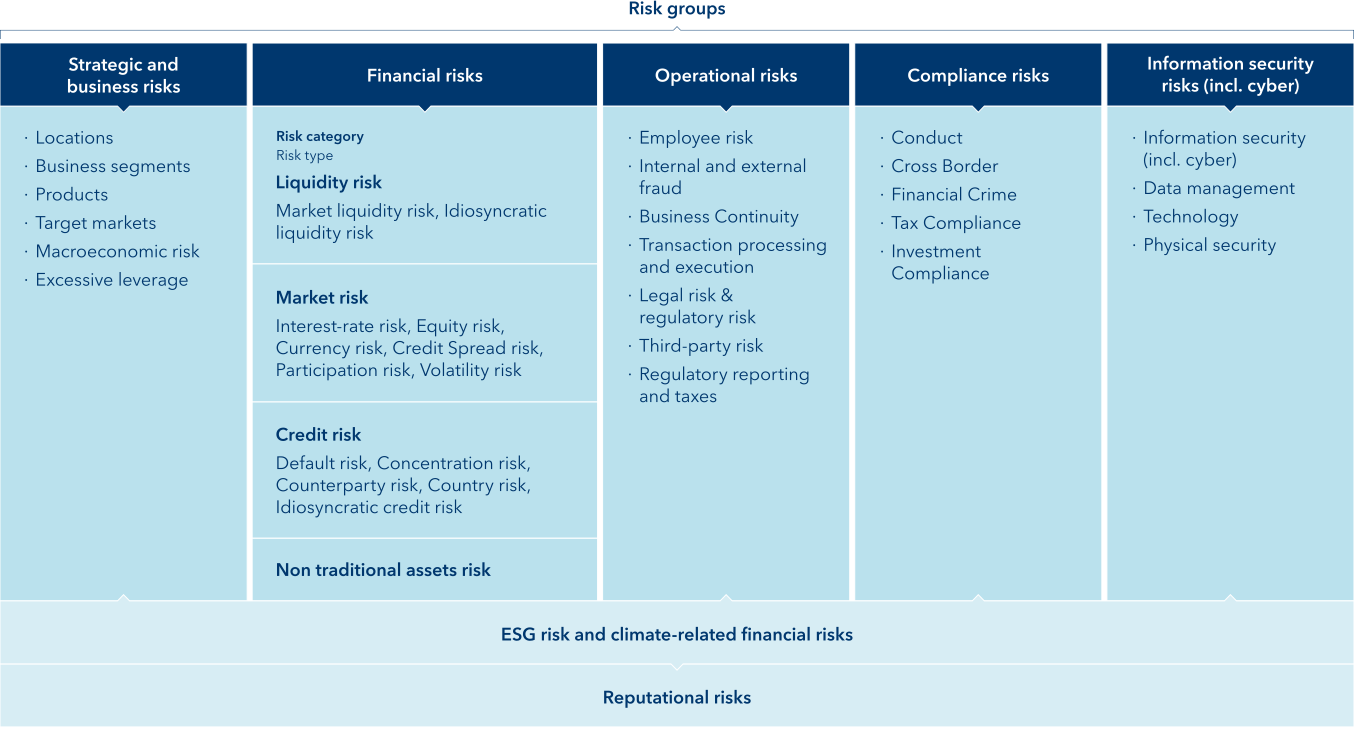
The above figure illustrates risk types, with the impact of ESG risks and climate-related financial risks as a driver in risk categories, and reputational risks as consequential risks.
Our risk management process includes comprehensive risk monitoring, which is functionally and organisationally independent of the risk-bearing units. Risk monitoring consists of risk controlling and risk reporting. VP Bank identifies and assesses ESG and climate-related financial risks using bottom-up and top-down analyses as part of the risk inventory. This forms the basis of risk identification and risk strategy. The results of the risk assessments form the basis of controlling and reporting.
The risks associated with climate change are considered financial risks to be integrated into the existing risk management framework. Risk management includes measures at all organisational levels to actively influence the bank risks classified as material. The risk appetite statement and other bank frameworks have been expanded to include ESG risks and climate-related financial risks. VP Bank is in the process of developing first-line guidelines for ESG and climate-related financial risk KPIs. At the same time, the corresponding second-line monitoring processes and risk reporting are being enhanced further.
Following the general risk management approach of VP Bank, based on the “lines of defence” framework, the same principles are applied to climate-related financial risks, with lines of defence having different roles and functions as shown in the table below.
Line of defence | Function | Description |
First | Risk management | Maintain effective internal controls and implement ESG risk and control procedures in day-to-day business. |
Second | Risk monitoring and compliance | Support in establishing controls in the first line of defence. Independent monitoring and reporting. |
Third | Internal Audit | Internal Audit provides independent and objective auditing and advisory services. |
In order to strengthen ESG risk management across the entire product universe of VP Bank Group, ESG criteria have been anchored in the architecture of the New Product Process (NPP) and the Product Review Process (PRP) since 2022. In the PRP, the results of the initial analysis are used and continuously adjusted. The assessment in the NPP is carried out by the Head of Group Sustainability or, as their deputy, by the CIO as representative in the Product and Pricing Committee (PCC). As part of the PRP, ESG criteria are incorporated as the additional “Sustainability” risk type in the scoring model.
In 2023, VP Bank introduced its Responsible Investment Policy, which factors sustainability criteria into all investments in which VP Bank makes the investment decision. VP Bank integrates sustainability criteria into all discretionary wealth management mandates, VP Bank funds and its own investments. The directive also applies to the recommendation list for advisory mandates in which the investment decision lies with the client themselves and where there may be deviations from bank policy as a result. Further information on the consideration of sustainability criteria in investment decisions can be found in chapter S4-1.
Aspects of energy efficiency and renewable energy play a role in the mortgage lending business. Energy-efficient renovations and the installation of renewable energy sources can reduce negative impacts on the environment. VP Bank does not currently offer any financing programme explicitly for energy-efficient renovations.
Actions and resources in relation to climate change policies (E1-3)
VP Bank has already implemented climate change mitigation adaptation measures, or these are currently being implemented. The following table provides a selected overview of action that has already been completed, or is planned or being implemented. Information on the resources and funding used to take this action will not be published for reasons of business confidentiality. VP Bank takes a wide range of operational measures to raise employee awareness and to reduce energy, water and paper consumption, as well as to prevent waste. It also has a system of environmental and mobility management. In addition, employees are encouraged to keep their travel as low-emission as possible.
Focus | Scope | Measures | Targets | Target achievement |
|---|---|---|---|---|
Climate protection | Downstream (Investments) | For on-balance shseet investments, VP Bank reviews investments in CO2-intensive sectors (oil and gas, cement and energy) to determine whether the counterparty has adopted a net-zero target by 2050. | Financed emissions from on-balance sheet investemnts result mainly from exposure to CO2-intensiven sectors. In these sectors, care is therefore taken to ensure that counterparties commit to achieving net zero by 2050 at the latest. | Implemented |
Climate protection | Downstream (Investments) | For on-balance sheet investments, VP Bank examines any investments in CO2-intensive sectors (coal, oil and gas, cement and energy) to determine whether the counterparty has a minimum level of emissions-related management quality. The Transition Pathway Initiative (TPI) method is used as the assessment benchmark. | This measure aims to ensure that the communicated net-zero ambition is acccompanied by an actual transition to a net-zero emissions path by the counterparties in the CO2-intensive sectors. | Implemented |
Climate protection | Downstream (loans) | Expansion of the database for building characteristics for more accurate measurement of financed emissions. | In order to accurately determine the financed emissions and develop targeted measures to reduce them, we are continuously working to expand the database and improve data quality. | In progress |
Climate change adaptation | Downstream (loans) | Collection of information on the exposure of our mortgage portfolio to natural hazards. | The recording of natural hazards in the mortgage portfolio aims to provide a better understanding of the potential financial risks. | Implemented |
Climate protection | Own operations | In principle, only company cars with WLTP emissions of 95 g CO₂/km or less are allowed. It is recommended to choose fully electric or hybrid vehicles. | The restructuring of the vehicle fleet at the Luxembourg location should reduce Scope 1 emissions and thus reduce the environmental impact. | Implemented |
Climate protection | Own operations | Switch from physical to digital brochures as part of the account opening process. | By eliminating the need for physical brochures, resources and costs were saved and the associated emissions were reduced. | Implemented |
Climate protection | Own operations | Feasibility study regarding the possibilities at the BVI location to switch to renewable energy sources and to become energy self-sufficient. | This measure should help to further reduce VP Bank's Scope 2 emissions and thus reduce the negative effects resulting from the use of fossil fuels. | In progress |
Climate change adaptation | Own operations, downstream | Carrying out climate scenario analyses as a basis for the development of adaptation strategies. | A quantitative climate scenario analysis is planned for 2025 in order to better understand the effects of climate change on VP Bank and to take appropriate targeted measures to reduce amy possible financial risk. | Planned |
Targets related to climate change mitigation and adaptation (E1-4)
VP Bank focuses on the areas of the value chain with the greatest relevance to the climate. Drawing on our dual materiality assessment and in line with general industry practice, VP Bank’s main climate-relevant IROs originate from our downstream activities. The focus is on activities further along the value chain on which VP Bank has the greatest direct impact. Building on the overarching objectives in chapter ESRS 2 MDR-T, the specific climate-related goals are described below.
The following table provides an overview of the overarching climate goals of VP Bank. In principle, VP Bank focuses on action to reduce emissions on the path to achieving goals. All greenhouse gas emissions reported in the current reporting year are gross figures. The metrics are calculated internally. The targets related to environmental matters are currently not based on conclusive scientific evidence and have not been validated externally.
Value chain | Scope | Scope (category) | Unit | Target year | Target Value | Reference period | Reference value | Reporting year |
Own operations | Scope 1 | - | tCO2e | 2030 | 9.9 | 2024 | 37.5 | 37.5 |
Upstream | Scope 2 | market-based | tCO2e | 2030 | 51.7 | 2024 | 185.3 | 185.3 |
Up- and downstream | Scope 3 | 2, 5, 6, 7 | tCO2e | 2050 | n/a1 | 2024 | 3,837.8 | 3,837.8 |
Downstream | Scope 3 | 15 (own investments) | tCO2e | 2050 | n/a1 | 2024 | 222,975.7 | 222,975.7 |
1Net-zero ambition: At present, there are no gross targets for Scope 3 emissions; these will be developed as part of the transition plan for climate change and published in the 2025 Annual Report.
Operational emissions
For direct Scope 1 emissions and energy-related Scope 2 emissions, VP Bank has set itself the goal of achieving net zero by 2030, as well as the corresponding time-based gross emissions targets as shown in the table. In the area of Scope 1 emissions, VP Bank aims to reduce greenhouse gas (GHG) emissions by 73.7 per cent, from 37.5 t CO2e in 2024 to 9.9 t CO2e in 2030. A key lever here is the conversion of the fleet to fully electric vehicles. For Scope 2 emissions, VP Bank aims to reduce greenhouse gas (GHG) emissions by 72.1 per cent, from 185.3 t CO2e in 2024 to 51.7 t CO2e in 2030. Where possible, VP Bank obtains energy from renewable sources to reduce its Scope 1 emissions.1 To calculate the gross targets, we used 2024 activity data and ecoinvent 3.10 emission factors to determine how high our emissions would be with all electric vehicles and renewable energies. This amount was then used as the target value.
VP Bank has set itself the goal of achieving net-zero upstream and downstream Scope 3 emissions by 2050. Gross targets for Scope 3 emissions are not yet available. They will be developed as part of the transition plan for climate change and published in the 2025 Annual Report. Within Scope 3 emissions, VP Bank distinguishes between operational emissions resulting from categories 2, 5, 6 and 7, and financed emissions in category 15. For VP Bank as a financial service provider, financed emissions in category 15 are material. They are set out in detail below.
Financed emissions
Financed emissions are recorded under “Investments” in downstream Scope 3, category 15. VP Bank has developed sector-specific intensity targets and action to decarbonise its own investments. These objectives are not validated externally. VP Bank applies a sectoral decarbonisation approach (SDA) based on the Transition Pathways Initiative (TPI) methodology. The SDA adopts a sector-specific method that compares companies within a sector with each other and sector-specific benchmarks. This comparison results in the performance of an average company in terms of international emissions targets.
VP Bank applies time-based and sector-specific targets as indicated at the time of the last industry TPI assessment for the “1.5°C scenario”. This scenario is consistent with the overarching goal of the Paris Climate Agreement to limit global average temperature rise to well below 2 degrees above pre-industrial levels, and make further efforts to limit temperature rise to 1.5 degrees from those levels. This corresponds to a carbon budget that limits the increase in the global average temperature to 1.5 degrees, with a probability of 50 per cent.
VP Bank builds on physical emission intensity and focuses on efficiency gains. This is in line with our goal to finance the transition to a low-carbon economy. In addition, material intensity metrics facilitate better internal progress monitoring and enhanced comparability in sectors with similar product mixes. This can reduce the impact of economic cycles and the associated business growth or contraction. At the same time, physical intensity metrics remain unaffected by an expansion of the business units included and an increase or reduction in assets under management per business unit.
Sector | NACE | Scope | Unit | Target year | Target3 | Reference year | Reference Value4 | Reporting year4 |
Oil & Gas | B6 | 1, 2, 31 | gCO2e/MJ | 2030 | 46.76 | 2024 | 71.65 | 71.65 |
Energy | D35.11 | 12 | tCO2e/MWh | 2030 | 0.19 | 2024 | 0.20 | 0.20 |
Cement | C23.5 | 1 | tCO2e/t | 2030 | 0.42 | 2024 | 0.55 | 0.55 |
Coal | B5 | 1 | tCO2e | 2024 | 0.00 | 2024 | 0.00 | 0.00 |
1We refer to the carbon intensity of the primary energy supply in accordance with the TPI method and take into account Scope 1, 2 and 3 (category 11) emissions from the companies' own electricity generation.
2We refer to the carbon intensity of electricity generation in accordance with the TPI method and take into account the Scope 1 emissions from the companies' own electricity generation.
3Target values are based on the TPI methodology for the 1.5°C scenario.
4The indicator is calculated as a weighted average based on the investment volume in the sector.
Operational action to achieve the goals described above for our own investments is based on the TPI. Accordingly, two criteria have been introduced into the investment decision-making process for the bank’s own investments. These must be met if a company belongs to one of the aforementioned emissions-intensive sectors: (i) The company must commit publicly to a net zero target by 2050 or earlier, and (ii) it must have a TPI management score of three or higher. In this way, reportable investments will gradually be aligned to the net zero target.
Where own investments are concerned, debentures are held up to maturity in accordance with the VP Bank business model for financial investments and are thus recognised at amortised cost. Early sale is therefore only possible in exceptional cases. This leads to time-bound emissions and a transitional phase with regard to the operational adjustments described below to take climate-relevant criteria into account when making own investments. Assuming an average seven-year investment horizon, the last securities that were not bought according to the criteria set in 2023 will fall due around 2030.
In view of the continuing lack of data in some areas, intensity-based metrics may vary from year to year until data collection improves. Future reporting years will likely include recalibrated year-on-year figures to ensure better data availability and consistent progress monitoring. If no company-specific emissions and/or productivity data is available, a sector-specific average method is used. The industry average is based on information provided by the TPI for each industry and year.
Gross Scopes 1, 2 and 3 and total GHG emissions (E1-6)
VP Bank reports on Scope 1, Scope 2 and Scope 3 emissions in accordance with the guidelines of the Greenhouse Gas Protocol and the operational control approach (CSRD). In other words, it focuses on operational activities, relationships and assets that can be managed directly. The following Scope 3 emission categories fall within our Scope 3 emissions inventory: categories 2, 5, 6, 7 and 15. Although Scope 3 categories 2, 5, 6, and 7 were not judged to be material, VP Bank discloses them because of their fundamental relevance to the fullest possible overall picture of the greenhouse gas inventory. No Scope 3 category 1 emissions are published because of the great uncertainty currently attached to their calculation. This will be pursued and reviewed over the next years. The basis for calculating greenhouse gas emissions corresponds to the reporting entity defined in ESRS 1. No emissions are regulated under emissions trading schemes.
Retrospective | Milestones and target years | ||||||
Base year (2024) | Reporting year (2024) | % (2024 / 2023) | 2025 | 2030 | 2050 | Annual % target / Base year | |
Scope 1 GHG emissions | |||||||
Gross Scope 1 GHG-emissions (tCO2e) | 37.5 | 37.5 | 0.0 % | - | 9.93 | - | 19.9 % |
Scope 2 GHG emissions | |||||||
Gross location-based Scope 2 GHG-emissions (tCO2e) | 507.8 | 507.8 | 0.0 % | – | – | – | – |
Gross market-based Scope 2 GHG-emissions (tCO2e) | 185.3 | 185.3 | 0.0 % | – | 51.74 | – | 19.2 % |
Significant scope 3 GHG emissions | |||||||
Total Gross indirect (Scope 3 ) GHG-emissions (tCO2e) | 537,268.0 | 537,268.0 | 0.0 % | – | – | – | – |
2 Capital Goods | 35.6 | 35.6 | 0.0 % | – | – | n/a2 | – |
5 Waste generated in operations | 171.5 | 171.5 | 0.0 % | – | – | n/a2 | – |
6 Business travel | 1,055.1 | 1,055.1 | 0.0 % | – | – | n/a2 | – |
7 Employee commuting | 2,575.7 | 2,575.7 | 0.0 % | – | – | n/a2 | – |
15 Investments1 | 533,430.2 | 533,430.2 | 0.0 % | – | – | n/a2 | – |
Total GHG emissions | |||||||
Total GHG emissions (location-based) (tCO2e) | 537,813.3 | 537,813.3 | 0.0 % | ||||
Total GHG emissions (market-based) (tCO2e) | 537,490.8 | 537,490.8 | 0.0 % | ||||
1Category 15 corresponds to the financed GHG emissions, which are explained in more detail later in this chapter.
2Net-zero ambition: At present, there are no gross targets for Scope 3 emissions; these will be developed as part of the transition plan for climate change and published in the 2025 Annual Report.
3The residual emissions result from the monthly tests of the diesel-powered emergency power generators at the various locations. These start automatically in the event of a power failure. A small proportion is also due to the annual replacement of the refrigerant fluid in the air conditioning systems.
4The residual emissions result from «embodied emissions» from the infrastructure, maintenance, and other lifecycle activities of renewable energy sources, excluding the emissions at the point of combustion.
GHG intensity per net revenue | N (2024) | % N / N-1 |
Total GHG emissions (location-based) per net revenue (tCO2e/CHF 1,000) | 1.6 | n/a |
Total GHG emissions (market-based) per net revenue (tCO2e/CHF 1,000) | 1.6 | n/a |
Reconciliation of the net revenue | Reference |
Total net revenue1 | 330.5 |
1The net revenue for the GHG intensity calculation corresponds to the total operating income for the current reporting year.
Operational activity data and emission factors
Primary data is used where possible for activity data for GHG emissions under Scope 1, 2 and 3 (categories 2, 5, 6, 7). This is location-specific data drawn directly from the supplier or from internal processes. To be exact, 82.6 per cent of our emissions disclosures during the reporting period are based on primary activity data. In the few cases in which no primary data was available, VP Bank used either secondary data (less than one per cent) or a mixture of primary and secondary data (16.6 per cent). “Secondary data” refers to assumptions based on national data or averages for other locations where there was no other primary data. At VP Bank Switzerland, for example, there was no information on the means of transport used by employees to get to and from work, which is why national data from the Swiss Federal Statistical Office was used.
Where possible, total emissions or the emission factor for an activity under Scope 1, 2 and 3 (categories 2, 5, 6, 7) emissions come directly from suppliers. Over the reporting period, 25.4 per cent of our total greenhouse gas emissions were calculated using our suppliers’ emission factors. In cases where this data was not available, the ecoinvent 3.10 database containing 2021 Global Warming Potential 100 (GWP 100) figures from the Intergovernmental Panel on Climate Change (IPCC) was used. These figures were used for 74.4 per cent of emissions. If no emission factors were available from the supplier or ecoinvent, values from other published sources were used. These were used for less than one per cent of our corporate emissions during the reporting period and included an emission factor from the Carbon Leadership Forum applied to office renovations.
GHG Protocol indicators are used to assess data quality. These address the representative nature of data in terms of technology, time and geography, as well as the completeness and reliability of data collection. In cases where no primary data is available, assumptions and estimates are made on the basis of secondary data sources. These limitations can affect the accuracy of the greenhouse gas emissions reported. Efforts are being made to improve the accuracy and completeness of this data. To detect transcription errors and inconsistencies, all data is automatically marked if it deviates by more than five per cent from the previous year’s data. To improve data quality there are plans continuously to improve data collection and emission factor data. In addition, each location must perform data plausibility checks.
Financed GHG emissions
The emissions financed by VP Bank are classified as Scope 3, category 15: “Investments” are recorded and are material to financial institutions. VP Bank reports on GHG emissions from the lending and investment business, with the latter including VP Bank’s own investments, as well as client assets for which investment decisions are made by VP Bank. The methodology follows the guidelines of the Partnership for Carbon Accounting Financials (PCAF). In the lending business, VP Bank records financed emissions from commercial real estate and mortgages, as well as corporate loans.1 The following asset classes are included when calculating financed emissions from direct investments and funds in the investment business: exchange-listed equities, corporate bonds and government bonds. VP Bank does not offer project or vehicle financing. Cash holdings and derivatives are not relevant to the calculation of financed emissions, and reduce the coverage ratio accordingly.
GHG emissions from mortgage receivables are calculated using approximation values based on the PCAF database for European building emission factors (version of August 2023). The emission factors used are country-specific and differ between residential and commercial real estate. Where residential real estate is concerned, we mapped the mortgage portfolio across the single-family home, multiple-family home and residential buildings (average) categories, and applied the corresponding factors per building (t CO2e/#). For commercial real estate, we replicated the portfolio in the office, hotel and non-residential buildings (average) categories, and applied the corresponding factors per building (t CO2e/#). The trade-off for deciding to apply a uniform collection methodology to all mortgage claims was therefore lower accuracy at the individual position level. This is due to the fact that the database of internal systems regarding building characteristics for existing properties is currently still limited. For example, building characteristics required for Liechtenstein (e.g. energy sources) are not publicly available in a building and housing register.
Third-party data on the GHG emissions actually reported by companies is used to determine financed emissions from the investment business. To ensure the best possible data quality, this is reviewed manually via spot checks on companies’ annual reports.
Type | Position | Account | Volume (in CHF 1'000) | Not covered (in CHF 1'000) | Coverage ratio (in %) | Emissions1 (tCO2) | Intensity (tCO2/Mio. CHF) | PCAF Quality2 (Score 1-5) |
Loans | Due from clients | Mortgage receivables4 | 3,727,549 | 51,371 | 98.6 % | 6,788 | 1.8 | 5.0 |
Non-mortgage receivables5 | 42,140 | 32,756 | 22.3 % | 290 | 30.9 | 2.0 | ||
Own investments | Receivables arising from money market papers | – | 171,749 | 1 | 99.9 % | 26,585 | 154.8 | 4.0 |
Due from banks3 | – | 850,681 | 850,681 | 0 % | – | – | – | |
Financial instruments | measured at fair value | 192,990 | 50,633 | 73.8 % | 17,642 | 123.9 | 2.2 | |
measured at amortised cost | 2,227,254 | 178,669 | 92.0 % | 178,748 | 87.3 | 2.8 | ||
Client assets | Assets in discretionary asset management accounts | – | 4,484,700 | 306,692 | 93.2 % | 261,470 | 62.6 | 2.7 |
Assets in self-administered investment funds | VP Bank Fonds | 806,907 | 28,121 | 96.5 % | 41,906 | 53.8 | 2.5 | |
Total | 12,503,970 | 1,498,923 | 88.0 % | 533,430 | 48.5 | 3.5 |
1Scope 1 and 2 emissions of third-party companies are taken into account in the reported financed emissions of VP Bank.
2Calculation of the PCAF quality score does not take into account positions in funds.
3Balance sheet item «Due from banks» contains only sight deposits at other banks and is not relevant for the calculation of the financed issues.
4Account «mortgage receivables» includes commercial real estate and mortgages.
5Account «Non-mortgage receivables» refers to corporate loans.
Anticipated financial effects from material physical and transition risks and potential climate-related opportunities (E1-9)
Quantitative information on anticipated financial impacts will be published in the 2025 Annual Report. For the current financial year, VP Bank is taking the option of not providing this information, instead basing disclosures on a qualitative analysis drawn from two climate scenarios. Detailed information on this can be found in chapter E1-1.